
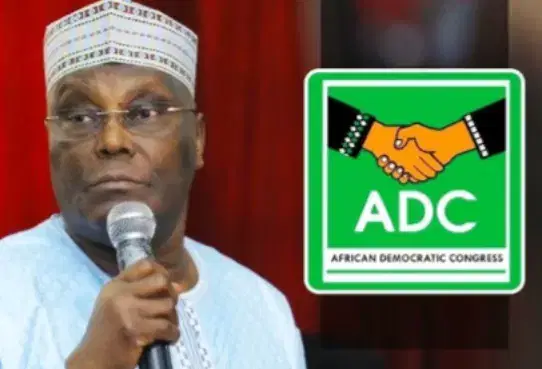
The Senior Political Assistant to former Vice President Atiku Abubakar, Demola Olarewaju, has defended the emerging opposition coalition being built around the African Democratic Congress (ADC).
Olarenwaju insisted that the arrangement is not structured around personal ambition but a wider democratic convergence of political actors.
Speaking on Monday, during an exclusive interview on Frontline, a current affairs programme on Eagle 102.5 FM, Ilese-Ijebu, Ogun State, Olarewaju began by situating Atiku’s political identity within what he described as a long-standing democratic tradition. He argued that Atiku has consistently demonstrated willingness to accept internal party outcomes, even when unfavourable.
According to him, this behaviour is not recent but deeply rooted in the former vice president’s early political experiences. He insisted that critics often overlook this historical pattern when analysing Atiku’s current political posture.
He traced Atiku’s political journey back to the early 1990s, arguing that it provides context for his present-day decisions. Olarewaju recalled that Atiku once ran for governor in 1992 under the military transition era. He explained that political disqualifications at the time altered the structure of the contest significantly.
This, he said, opened the space for younger political actors to step forward under mentorship structures.
For all breaking news and latest gist:
👉 JOIN GISTSMATE WHATSAPP CHANNELHe further narrated how Atiku’s political mentor, Shehu Musa Yar’Adua, influenced his early participation in national politics. According to him, Atiku was drafted into a presidential contest at a relatively young stage in his career. He noted that this was not originally his intended political path at that time. However, circumstances within the political space forced a reshuffling of candidates.
Olarewaju explained that several major candidates were disqualified during that era, altering the dynamics of the primaries. He mentioned figures such as Chief Samuel Oluyemisi Falae and Patrick Dele Cole as part of the affected political class. He argued that this created a vacuum that required younger politicians to step into national-level contests. Atiku, he said, became part of that unexpected political transition.
According to him, “Well, I think, um, I think I’ve got confidence as a, um, as a democrat is very clear and established within the polity. Um, Atiku Abubakar ran for governor in 1992. And, um, because he was under the military regime, he was disqualified and Shehu Musa Yar’Adua, his mentor, was also disqualified from the presidential race in the SDP by the military regime. And so, the Shehu Musa Yar’Adua camp brought Atiku Abubakar in to contest for president at the time, even though he was very young, he was only running for governor. But because, you know, the major candidates, Chief Samuel Oluyemisi Falae, Shehu Musa Yar’Adua, Patrick Dele Cole, the rest of them had been disqualified, the next generation had to step up. Atiku Abubakar contested, he came third in that primaries, um, behind M.K. Abiola, behind Babagana Kingibe, and he was third. And the Abiola camp reached out to the Yar’Adua camp and asked him to step down, and he stepped down in 1992. So, I think, you know, that was the beginning of his politics that establishes him as a democrat”.
He stated that Atiku eventually contested in the primaries and came third in the process. According to him, Atiku was behind prominent figures such as M.K. Abiola and Babagana Kingibe. He said this outcome was significant in shaping Atiku’s political temperament. It was from that moment, he argued, that Atiku’s political philosophy of accepting outcomes began to form.
“So, when he comes out to say that, um, I will support whoever emerges, whether by consensus or by direct primaries, it is exactly who he has always been,” he said.
Olarewaju added that despite not winning, Atiku’s political camp was later engaged by the Abiola camp. He said the request was for Atiku to step down in the broader interest of political consolidation. He confirmed that Atiku complied with that request at the time. This, he argued, was an early demonstration of political maturity and democratic discipline.
From that historical foundation, Olarewaju moved to Atiku’s later political experiences. He insisted that the pattern of accepting party decisions has remained consistent across decades. He referenced the 2011 PDP presidential primaries as a key example. In that election cycle, Atiku lost to then-President Goodluck Jonathan.
“Even in, um, 2011, if you remember, he lost the PDP presidential primaries to President Goodluck Jonathan, and he supported President Goodluck Jonathan and delivered votes for him in Adamawa and Goodluck Jonathan won Adamawa seat. In 2015, he lost the APC ticket to Muhammadu Buhari, and he supported him. So, I think, you know, it’s a thing for granted. If you go into a competition, um, if you go into a race, if you go into a contest, you must always be prepared for the possibility that you can lose. That’s just the democratic way. So, this is who Atiku Abubakar is. If he says that he will support whoever emerges, definitely, he would do that.
But I would also say that if he wins, we would also expect his opponents to support him and endorse him and not behave like, um, some persons behaved in the last, um, electoral cycle”. He said.
Olarewaju argued that even after that defeat, Atiku did not withdraw from the party structure. Instead, he said Atiku supported Jonathan and contributed politically in key regions. He claimed that this support extended to electoral mobilisation in Adamawa State. According to him, Jonathan still secured victory in that region despite Atiku’s loss at the primaries.
He also referenced the 2015 political transition as another defining moment. Olarewaju stated that Atiku lost the APC presidential ticket to Muhammadu Buhari during that period. Despite the defeat, he insisted that Atiku still supported Buhari in the general election. He described this as further evidence of Atiku’s willingness to align with party outcomes.
He said these repeated experiences demonstrate a political principle rather than isolated incidents. Olarewaju argued that anyone entering democratic competition must be prepared for both victory and defeat. He stressed that democracy is built on acceptance of outcomes. According to him, Atiku embodies this principle consistently across his political life.
Olarewaju then broadened the discussion to what he described as opposition political ethics in Nigeria. He argued that while Atiku has maintained loyalty after losses, others have behaved differently. He specifically referenced the aftermath of the last electoral cycle as an example. He claimed that some political actors did not maintain party loyalty after internal disagreements.
He cited former Rivers State Governor Nyesom Wike as part of this comparison. Olarewaju alleged that Wike’s post-election political alignment represented a break from expected party discipline. He argued that such behaviour undermines democratic consolidation. According to him, democracy requires both the willingness to win and the willingness to lose.
“the former governor of River State is now working for APC. You know, that is the way it should be. I think it was one of the political thinkers in the U.S. said if you do not have the stomach for defeat, then you have no rights to victory. And that’s what we believe also that, you know, your ability to win must also be underscored by a willingness to lose. That’s what makes us involved in those things. So, yes, Nyesom Wike lacked that in the last election, but you know, we believe that this is how it should be for anyone who claims to be a Democrat.,” he said.
He anchored this argument on a political philosophy often associated with democratic thinkers. He paraphrased the idea that victory without acceptance of defeat is incomplete. He said this principle is central to how Atiku views political engagement.
He insisted that Atiku’s public statements on consensus candidacy should be understood in that context.
Olarewaju maintained that Atiku’s position on supporting consensus outcomes is not rhetorical. He said it is backed by decades of political behaviour. He emphasised that Atiku has repeatedly demonstrated loyalty to party decisions. According to him, this makes current doubts about his commitment unnecessary.
He further argued that the same expectation applies in reverse. He stated that if Atiku eventually emerges as a candidate, others must also support him. He insisted that political fairness demands reciprocity. He said democracy cannot function properly if only one side is expected to accept defeat.
Olarewaju concluded this segment by reaffirming confidence in Atiku’s political behaviour. He said he does not foresee Atiku losing within the emerging coalition arrangement. He repeated the statement for emphasis during the interview.
According to him, “I don’t foresee him losing. I don’t foresee him losing. All we are saying is that, you know, if we do lose, we’ll do everything to win. But if we do lose, we’ll support whoever wins. So I don’t foresee him losing. I mean, the reason why I mentioned the spring of losses, you know, 1992, 2011, 2015, the reason why I mentioned that is to say that, look, loss does not, you know, the victory, the courage to win, you know, must also be underscored by the courage to lose.
“We’ve lost before. But again, in the past eight years, I don’t think there has been any political behemoth, you know, in opposition politics like Attica Abubakar. 2019, he won the PDP ticket, right, in Nyesom Wike’s backyard in River State.
“In 2023, he won the PDP presidential ticket, even though Wike was also an aspirant. He has won in those three years. So we don’t foresee him losing out within the ADC coalition. However, if that happens, then he would support whoever wins. At the end of the day, you know, what I do know is that every member, every leader in the opposition coalition, they are all working together to deliver a party for Nigerians where everyone is a stakeholder and where everyone works together. So for me, it is very clear that, you know, this is what will happen in the next election.
“We expect that Atiku will win. But regardless of who wins, whether it is the Excellency Peter Obi, whether it is the Excellency Rotimi Amaechi, or whether it is the Excellency Atiku Abubakar, which, you know, I hope for, you know, regardless of whoever the ADC coalition is going to remain together, and they are definitely going to remain strong”. he said, stressing his confidence in the process.
AGE, HEALTH, AND POLITICAL CAPACITY ARGUMENT
Olarewaju dismissed concerns around Atiku Abubakar’s age in the 2027 race, arguing that political judgment should not be dictated by critics. He insisted that public perception often distorts reality when filtered through opposition commentary. In his words, “whatever your critics say about you should never be your truth. If it was up to your critics, you wouldn’t even be alive. If it was up to your critics, Atiku wouldn’t even have run in 2023.” He maintained that the focus should remain on leadership capacity and national need rather than age narratives.
He further argued that age becomes irrelevant if competence and mental fitness are intact. According to him, the only valid concern is whether a candidate is physically and mentally sound. He said, “The age is not the issue. It would be health and the mind, and as far as the man is of sound mind and sound health, the critics are allowed to say whatever they feel.” He added that leadership suitability must be judged on capacity, not numerical age.
Olarewaju attempted to simplify his argument using a direct analogy about value over age. He stressed that Nigerians should prioritize outcomes over sentiment in leadership selection. He stated, “If an 80-year-old man gives me one million naira on this economy, I will take it and say thank you. If an 80-year-old man gives me a car on this Tinubu economy where everyone is broke, you will take it and say thank you.” He concluded that governance value outweighs demographic concerns.
He expanded the analogy further to emphasize that governance should be evaluated based on results. He argued that leadership debates are often unnecessarily emotional and disconnected from lived realities. He said, “If an 80-year-old man gives me good governance, why will I not accept it?” He maintained that age becomes irrelevant when leadership delivers measurable improvement in citizens’ lives.
Olarewaju concluded the exchange by arguing that Nigerians often over-intellectualize politics instead of focusing on practical outcomes. He insisted that leadership evaluation must be rooted in daily realities such as insecurity, economy, and governance quality.
In his words, “If your life is not okay now, and we agree that the present government has failed in insecurity, economy, and human capital development, then we must look at who can deliver.” He added that political ambition is universal, stating, “Everybody is fulfilling an ambition… the question is can this person deliver good governance?”
WARNING: If You Are Not 18+, Don’t Click The Link Below 👇🫣
https://wrathful-piano.com/zBn8jS
Did you want to monetize your website, join MONETAG or ADSKEEPER and start earning
Please don’t forget to “Allow the notification” so you will be the first to get our gist when we publish it.
Drop your comment in the section below, and don’t forget to share the post.
Never Miss A Single News Or Gist, Kindly Join Us On WhatsApp Channel:
https://whatsapp.com/channel/0029Vad8g81Eawdsio6INn3B
Telegram Channel:
https://t.me/gistsmateNG