
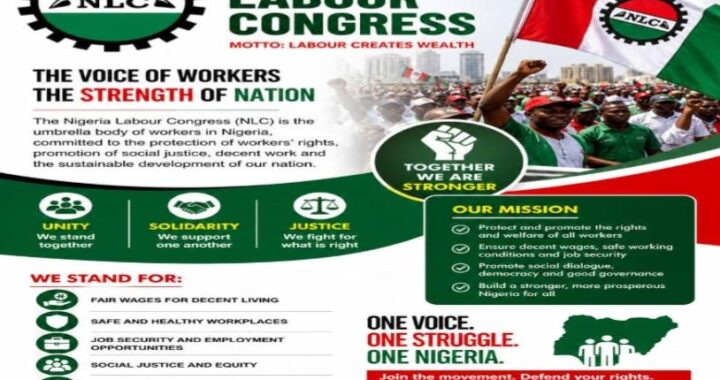
The idea of a workers’ union is not just an institutional arrangement—it is a living voice, a collective heartbeat, a moral compass in the ever-shifting terrain of labour, dignity, and national development.
In present-day Nigeria, where economic tides rise and fall with unsettling unpredictability, the relevance of a solid, dynamic, and proactive labour movement cannot be overstated.
At the center of this movement stands the Nigeria Labour Congress (NLC), alongside its allied bodies such as the Trade Union Congress of Nigeria (TUC) and various industrial unions. These institutions are not merely administrative platforms; they are the guardians of workers’ rights, the amplifiers of silent struggles, and the architects of social justice within the Nigerian state.
A strong workers’ union is, first and foremost, a shield. It protects the worker from exploitation, arbitrary dismissal, unsafe working conditions, and the erosion of wages by inflation. In a nation grappling with economic reforms, currency fluctuations, and rising living costs, unions serve as the negotiating table where fairness is demanded, not begged for. They transform individual vulnerability into collective strength.
Yet beyond protection, unions are engines of progress. A dynamic and proactive union does not only react—it anticipates. It studies policy directions, engages government constructively, and contributes meaningfully to national discourse. Through structured dialogue, strategic advocacy, and principled resistance when necessary, unions help shape policies that affect millions.
They remind leadership that governance is not complete until it reflects the welfare of the governed.
There is also a deeply human, almost poetic essence to unionism. It is the story of solidarity—the cleaner and the teacher, the civil servant and the artisan, standing shoulder to shoulder, bound not by uniformity but by shared purpose. It is the quiet assurance that no worker walks alone into uncertainty. In unity, there is dignity; in solidarity, there is power.
However, the expectations of workers’ unions in today’s Nigeria must evolve beyond traditional boundaries.
For all breaking news and latest gist:
👉 JOIN GISTSMATE WHATSAPP CHANNELThe future of formidable and dynamic unionism demands unions that are proactive thinkers, not merely reactive and subjective protesters—anticipating economic shifts and preparing workers for emerging realities such as digital transformation and automation. They must be transparent and accountable, ensuring that leadership truly reflects the aspirations of the rank and file.
Pragmatic union bodies must position themselves as strategic partners in development, working collaboratively with government and private sector stakeholders to create sustainable employment opportunities rather than merely contesting outcomes.
Equally, they must serve as educators and reformers—equipping members with the skills, knowledge, and awareness required to remain relevant in a competitive global economy.
The Nigerian worker today stands at a crossroads—between resilience and exhaustion, hope and hardship. In this delicate balance, unions must rise as both voice and vision. They must speak truth to power, yet also offer pathways to progress. They must challenge injustice, while cultivating cooperation where it yields collective benefit.
Ultimately, the strength of a nation’s workforce mirrors the strength of its unions.
When unions are vibrant, principled, and forward-looking, they do more than defend workers—they help stabilize democracy, foster economic growth, and build a society anchored on fairness.
So, the call is clear: let the unions be more than institutions—let them be movements of purpose. Let them carry not just the grievances of today, but the aspirations of tomorrow. And in that noble pursuit, may the Nigerian worker never lose their voice, their value, or their vision.