
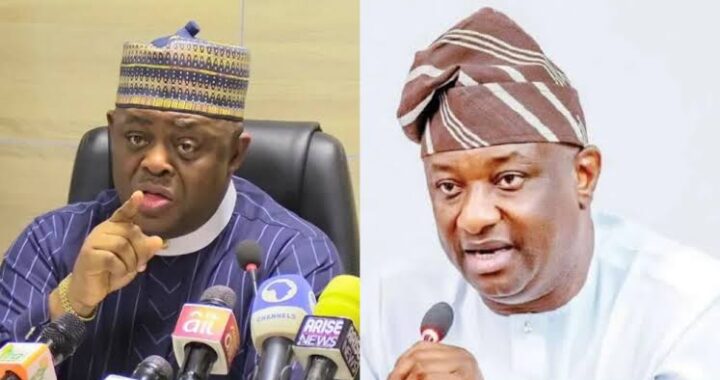
Minister of Aviation and Aerospace Development Festus Keyamo and his predecessor, Femi Fani-Kayode, have disagreed over the circumstances surrounding the collapse of Nigeria Airways and the role the administration in which former Vice-President Atiku Abubakar served played in liquidating the national carrier.
In a video posted on his official X account, Mr Abubakar said Nigerian families are going through hard times and struggling to afford food, healthcare, transport, and rent. At the same time, many live in fear of kidnapping and attacks.
“Bola made life expensive. I will work to make life affordable again and restore the security every Nigerian deserves,” he said.
In response, Mr Keyamo accused the former vice-president of hypocrisy, citing the liquidation of Nigeria Airways in 2004 and the long delay in settling its former workers’ entitlements.
He noted that the administration of former President Olusegun Obasanjo, in which Mr Abubakar served as the vice-president, left thousands of workers without pensions and gratuities.
According to Mr Keyamo, President Bola Tinubu approved and released ₦36 billion to settle the former employees’ outstanding entitlements, adding that beneficiaries have begun receiving payment.
For all breaking news and latest gist:
👉 JOIN GISTSMATE WHATSAPP CHANNEL“Twenty-two years later, after many of them have died out of frustration, President Bola Ahmed Tinubu is now clearing the mess you left behind,” he said.
He also criticised Mr Abubakar for taking credit for the Obasanjo administration’s achievements when convenient, while distancing himself from its decisions when criticised.
– Fani-Kayode Defends Obasanjo
Mr Fani-Kayode, Nigeria’s aviation minister from November 2006 to May 2007, challenged Mr Keyamo’s account of the airline’s collapse in a post on X on Thursday.
He asserted that the airline was already in severe decline before Mr Obasanjo returned to power in 1999, and went further to say Nigeria Airways had 32 functional aircraft when the former president left office as a military head of state in 1979. Still, by 1999, he had only one aircraft left.
“The company was liquidated primarily due to chronic insolvency, operational collapse and mismanagement in its operations which took place between 1979 and 1999,” he said.
Mr Fani-Kayode argued that the Obasanjo administration had little or no choice but to liquidate the airline after years of decline and failed attempts to revive it.
He also disputed the claim that the administration was solely responsible for the unpaid entitlements of former employees, saying the issue of their pensions remained unresolved even after the airline was wound up.
Mr Fani-Kayode said that, as aviation minister in 2006, he presented a memorandum to the Federal Executive Council seeking approval to pay outstanding pensions to former Nigeria Airways workers.
According to him, the memorandum was rejected after some cabinet members opposed the payment, arguing that former board members and management officials contributed to the airline’s collapse.
Mr Fani-Kayode said he disagreed with that position but could not secure approval for the proposal.
He added that the matter was taken up by the administration of former President Umaru Musa Yar’Adua, which paid most of the pensioners. At the same time, the administration of Muhammadu Buhari also made payments.
Mr Fani-Kayode commended the current administration for settling the outstanding entitlements but said the payments should have been made earlier.
– How Nigeria Airways Collapsed
Nigeria Airways began in 1958 as WAAC (Nigeria) Ltd, following the restructuring of the West African Airways Corporation.
The Federal Government originally held a 51 per cent stake in it, while other shares were held by Elder Dempster Lines and British Overseas Airways Corporation. The government became the airline’s sole shareholder in 1961.
The airline operated domestic and international routes, connecting Nigerian cities with destinations across Africa, Europe and North America. At its peak, it was a prominent part of the country’s aviation industry.
However, its fortunes deteriorated over several decades amid mounting debt, poor management, political interference, overstaffing, and corruption allegations.
The airline had a fleet of 32 aircraft in 1984, which fell to three by October 2000. By May 2003, its fleet had reportedly shrunk to one aircraft amid financial distress and operational difficulties.
The airline’s financial trouble also affected its international operations. In early 1987, the International Air Transport Association suspended it from its clearing house over accumulated debts exceeding $1.1 million. The suspension constrained its ability to issue tickets involving other member airlines through the clearing system.
Investigation into alleged corruption
The airline’s decline also prompted an investigation into allegations of corruption and financial mismanagement.
In 2001, the Obasanjo administration appointed a judicial commission to investigate the airline’s affairs during military rule from 1983 to 1999.
A November 2003 report by South Africa’s Business Report said a government white paper on the investigation detailed an alleged $400 million graft case involving former aviation ministers, former managing directors, and other officials associated with the airline.
The report also said the investigation identified alleged over-invoicing, questionable payments, and other financial irregularities. It also reported that the commission recommended recovering more than $400 million from companies and former officials implicated in its findings, with some individuals recommended for prosecution.
Efforts to rescue the carrier through restructuring and privatisation failed to restore its operations. The International Finance Corporation, the World Bank Group’s private-sector arm, was engaged to advise on the privatisation process but later withdrew.
The airline ceased operations in 2003.
– FG Pays N18 Billion In Former Workers’ Benefits
The dispute over Nigeria Airways has continued long after the airline stopped operating, particularly over the pensions and severance benefits owed to its former employees.
In January 2025, PREMIUM TIMES reported that the National Assembly’s Joint Committee on Aviation said the Federal Government owed former Nigeria Airways workers N36 billion. The lawmakers threatened to withhold approval of the aviation budget unless provisions were made for the payment.
In May 2026, former workers again appealed to the Federal Government to release the outstanding entitlements. In July, a ministerial committee was preparing to oversee the disbursement.
The Federal Government had earlier paid severance benefits to 2,100 former workers, while another 600 beneficiaries had been cleared for payment. The benefits across the nine batches amounted to N18 billion.
The Ministry of Finance said President Tinubu had earlier approved the settlement and directed that the matter be concluded. The ministry said the process involved identifying eligible beneficiaries, validating records, and establishing financial obligations before payments began.
WARNING: If You Are Not 18+, Don’t Click The Link Below 👇🫣
https://nya5.com/link?z=11857196&var=
Did you want to monetize your website, join MONETAG or ADSKEEPER and start earning
Please don’t forget to “Allow the notification” so you will be the first to get our gist when we publish it.
Drop your comment in the section below, and don’t forget to share the post.
Never Miss A Single News Or Gist, Kindly Join Us On WhatsApp Channel:
https://whatsapp.com/channel/0029Vad8g81Eawdsio6INn3B
Telegram Channel:
https://t.me/gistsmateNG