
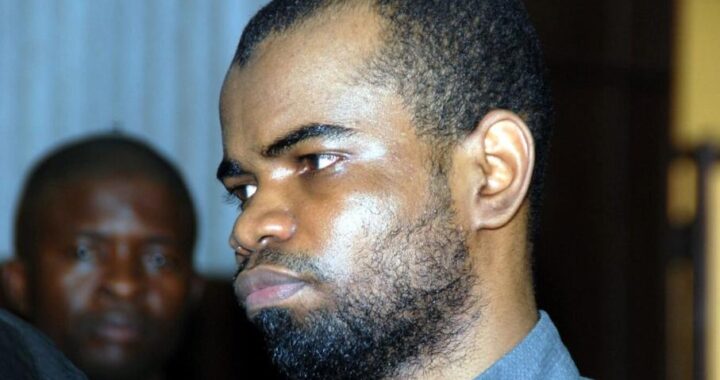
Kabiru Umar Sokoto, the Boko Haram bomber, has appealed his terrorism conviction by the federal high court in Abuja.
Sokoto, through his counsel, Don Akaegbu & Company, filed an application dated May 13, 2026, at the Abuja court of appeal.
THE CASE
On December 20, 2013, Sokoto was convicted and sentenced to life imprisonment over the Christmas Day bombing of St Theresa Catholic Church in Madalla, Niger state, which killed at least 37 people and injured 57 others.
In July 2022, Sokoto had been planning to kidnap the children of Kashim Shettima, then-governor of Borno state, when he was arrested in January 2012.
He was initially arrested at the Borno governor’s lodge in Asokoro, Abuja, before he escaped from police custody and was re-arrested a month later in Taraba state.
‘WHY APPEAL PROCESS WAS DELAYED’
In the motion of notice, Sokoto’s counsel prayed the court of appeal for leave to file his notice of appeal out of time and for the notice already filed to be deemed properly filed and served.
The convict told the court that the delay in filing the appeal was caused by his prolonged incarceration, repeated transfers across different custodial facilities, and the deaths of two lawyers earlier engaged for the case.
“The Applicant was convicted and sentenced to life imprisonment on 20th December, 2013. The Applicant has been continuously incarcerated since then,” the court filing reads.
“The Applicant was moved across several custodial centres across different States, making access to counsel extremely difficult.
“The Applicant’s trial counsel initiated steps toward appeal but died before perfecting same. Another counsel engaged thereafter also passed away before prosecuting the appeal.
“A letter written by the trial counsel requesting compilation of records exists but the appeal was not completed. The delay was not deliberate but occasioned by circumstances beyond the control of the Applicant.”
The application for an extension of time to appeal was filed because the 90-day deadline for appealing the criminal conviction had elapsed.
THE AFFIDAVIT
In an affidavit, Lawal Suleiman, nephew of the convict, said the family was unable to locate Sokoto at the maximum security custodial facility, Kirikiri, Lagos, in March 2026.
Suleiman said that since the incarceration of Sokoto at different custodial facilities, his health had deteriorated.
“The Applicant is presently detained at the Maximum Security Custodial Facility, Kirikiri, Lagos State, a facility far removed from his family and community in Sokoto State,” the affidavit reads.
“The conditions of a maximum security custodial facility, combined with his prolonged incarceration, have taken a visible and grievous toll on his physical and psychological well-being.
“During my visit to him in March 2026, I personally observed that the Applicant’s health has deteriorated significantly since his incarceration commenced.
“He has aged considerably beyond his years and is in manifest need of medical attention that the custodial facility is not adequately providing.
“The Applicant is the principal provider for his family. His elderly parents, wife, and children have been without his support, presence, and care for over fourteen years.
“His aged parents, in particular, are in declining health and advancing years, and the Applicant has expressed to me, in the most compelling terms, his profound anxiety that he may never see his parents alive again if this appeal is not heard with dispatch.
“The Applicant has consistently maintained his innocence of the charges brought against him. He has at all material times been desirous of exercising his constitutional right of appeal guaranteed under Section 36 of the Constitution of the Federal Republic of Nigeria, 1999 (as amended).”
GROUNDS FOR APPEAL
The proposed appeal filed by the convict was anchored on 12 grounds.
The convict asked the court to appeal to set aside his conviction and acquit him of the two-count charge preferred against him by the federal government.
He argued that the trial judge erred by convicting him of an offence under section 15(2) of the Economic and Financial Crimes Commission (Establishment) Act, 2004, which is a financial crime and not terrorism.
The convict said the prosecution failed to establish a nexus between him and any specific terrorist act at Mabira, Sokoto state, between 2007 and 2012.
“The learned trial Judge erred in law when he held that the prosecution discharged its burden of proof beyond reasonable doubt on both counts of the Second Amended Charge, whereas the prosecution demonstrably failed to prove the essential ingredients of either offence against the Appellant,” the notice of appeal reads.
“On Count One: The prosecution failed to adduce credible and direct evidence establishing that the Appellant committed or facilitated any of the acts of terrorism particularised in the charge, or that there was any nexus between the Appellant and any specific terrorist act at Mabira, Sokoto State, between 2007 and 2012.”
WARNING: If You Are Not 18+, Don’t Click The Link Below 👇🫣
https://wrathful-piano.com/zBn8jS
Did you want to monetize your website, join MONETAG or ADSKEEPER and start earning
Please don’t forget to “Allow the notification” so you will be the first to get our gist when we publish it.
Drop your comment in the section below, and don’t forget to share the post.
Never Miss A Single News Or Gist, Kindly Join Us On WhatsApp Channel:
https://whatsapp.com/channel/0029Vad8g81Eawdsio6INn3B
Telegram Channel:
https://t.me/gistsmateNG