
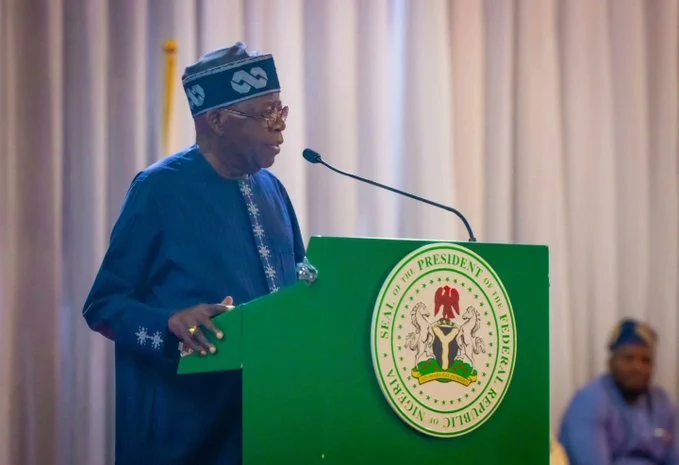
President Bola Tinubu says the removal of subsidy on premium motor spirit (PMS), also known as petrol, is designed to free up budgetary resources for critical investments.
Tinubu spoke on Tuesday during the 17th annual Chartered Institute of Bankers of Nigeria (CIBN) banking and finance conference in Abuja.
He was represented by Vice-President Kashim Shettima.
On May 29, 2023, Tinubu announced the removal of subsidy on petrol — a development that immediately led to a spike in the price of PMS, as well as goods and services.
Speaking at the conference, the president said his administration has taken courageous steps to reform Nigeria’s macroeconomic environment, with a focus on restoring confidence in the nation’s economy.
“We have taken bold steps to reform the macroeconomic environment. Our focus is on restoring confidence in the Nigerian economy through measures aimed at reducing inflation, stabilising the foreign exchange market, and improving fiscal management,” Tinubu said.
Follow us for breaking news:
👉 JOIN WHATSAPP CHANNEL“Though painful in the short term, the removal of fuel subsidies is designed to free up budgetary resources for critical investments in infrastructure and social services, frequent adjustment of the monetary policy rate, a move aimed at curbing inflation and fostering a more market-oriented exchange rate system.”
However, there have been reports that the federal government has restored subsidy payments on petrol.
On August 19, TheCable reported that Tinubu approved a request by the Nigerian National Petroleum Company (NNPC) Limited to utilise the 2023 final dividends due to the federation to pay for the petrol subsidy.
On the same day, NNPC denied the return of subsidy, however, it later confirmed subsidising petrol, as the company said the federal government owes it N7.8 trillion for petrol subsidy.
Also, on September 1, NNPC admitted to owing suppliers of petrol, adding that it is facing financial strain due to the petrol supply costs.
The debt was due to the difference in the landing costs, which was reported to be around N1,200, and the pump price of petrol (N600 per litre) — although NNPC has now increased the price of petrol to N855 per litre.
On April 15, Nasir el-Rufai, former governor of Kaduna state, said the federal government is spending more on petrol subsidy than before.
Two days later, Gabriel Ogbechie, chief executive officer of Rainoil Limited, claimed the government now spends N600 billion on petrol subsidy monthly.
Also, Agora Policy, an Abuja-based think tank, on September 1, said petrol subsidy will reach an all-time high in 2024 after gulping N4.2 trillion from January to July.
‘CONFERENCE HELD AT THE RIGHT TIME’
The president described the theme of this year’s conference, “Accelerating Economic Growth and Development: The State of Play and the Way Forward,” as both timely and necessary.
He said Nigeria faces interrelated challenges such as high inflation, rising costs of living, unemployment, infrastructure deficits and effects of global economic shifts.
Tinubu, however, said the challenges also present opportunities for growth and development.
“This theme will enable us to evaluate where we stand as a nation, understand the root causes of our economic challenges, and explore actionable strategies to accelerate growth and development sustainably and inclusively,” he said.
‘WE’RE COMMITTED TO STRENGTHENING INFRASTRUCTURE DEVELOPMENT’
Tinubu reaffirmed his administration’s commitment to strengthening infrastructure development in the ongoing bid to grow Nigeria’s economy.
He said the administration is investing in roads, railways and energy projects through public-private partnerships to reduce transportation costs and improve market access.
The president also underscored the government’s prioritisation of the digital economy, which he said would drive innovation and financial inclusion.
“We are expanding broadband penetration and encouraging the growth of tech startups through initiatives such as the Digital Nigeria program,” he said.
“For example, we currently train three million Nigerian youths in digital technology and essential skills and then deploy them to innovation hubs.
“These efforts are designed to create jobs, increase productivity, and make financial services more accessible to Nigerians in all corners of the country.
“It is essential to state that we are committed to achieving a 70% digital literacy level by 2027 through innovative approaches in delivering initiatives, continuous collaborations and stakeholder engagement.”
Also, the president called for collaboration across all sectors, including the government, private industry and civil society organisations, stressing that in order to achieve sustained economic growth, it is essential for everyone to align their policies and actions intentionally with the changing global landscape.
He expressed optimism that the conference would serve as a platform for sharing ideas, exchanging knowledge and exploring innovative solutions to the challenges facing the nation.
Tinubu said the conversations during the event would enable a thorough examination of the critical problems affecting the financial system and economy, identify growth opportunities and collectively shape the future of banking and finance in Nigeria.
Don’t Miss The Opportunity Awaiting You. Click the link below 👇
https://faikudoka.net/4/5193489
Please don’t forget to “Allow the notification” so you will be the first to get our gist when we publish it.
Drop your comment in the section below, and don’t forget to share the post.
Never Miss A Single News Or Gists, Kindly Join Us On WhatsApp Channel:
https://whatsapp.com/channel/0029Vad8g81Eawdsio6INn3B
Telegram Channel:
https://t.me/gistsmateNG