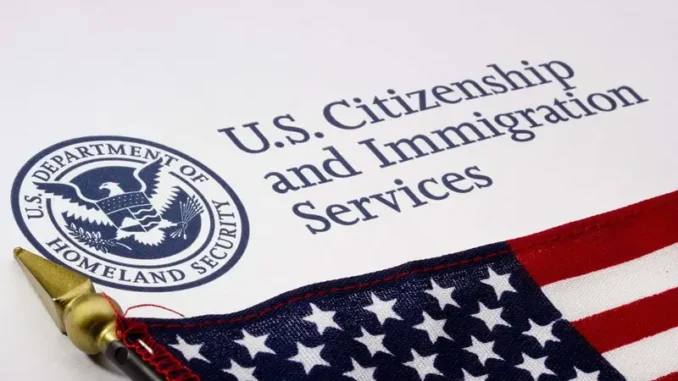
The U.S. Citizenship and Immigration Services (USCIS) has told a federal court that concerns about Nigerian documents being unreliable and public officials falsifying records prompted its decision to implement policies to halt the processing of green card, work permit, and other immigration benefit applications for its citizens.
The deputy director of USCIS, Angelica Alfonso-Royals, stated this in her declaration submitted on Friday at the U.S. District Court for the District of Rhode Island, defending the agency’s policies placing pending benefit applications of Nigerians and nationals of 38 other countries on hold after they were restricted from entering the U.S. over terrorism and public safety threats.
The USCIS said it was important that officials “place an adjudicative hold on all pending benefit requests submitted by or for aliens from the high-risk countries” after President Donald Trump’s December 2025 and January 2026 proclamations.
On June 11, District Judge John McConnell invalidated the directives, ruling that the Trump administration lacked the statutory and regulatory authority to implement them.
Even though the agency said in a statement that it disagreed with the judgment, it announced that it would resume processing pending benefit requests and pursue any further judicial review.
In her declaration, Ms Alfonso-Royals, said USCIS conducts screening and vetting, noting that concerns arose after the agency found that some naturalisation and permanent residence applications had previously been approved based on unreliable information.
For all breaking news and latest gist:
👉 JOIN GISTSMATE WHATSAPP CHANNELShe said it was discovered that the affected countries “possess little to no credible identity management infrastructure,” making it difficult, if not impossible, to verify their identities. She also cited concerns of corruption and falsification of documents.
The deputy director specifically mentioned Somalia, Yemen, Afghanistan, Nigeria, Pakistan, South Sudan, Liberia, Ethiopia, Angola, and Sierra Leone.
“Nigerian documents also have limited credibility due to corruption. In Nigeria, it is common for government officials to falsify records,” Ms Alfonso-Royals said. “Furthermore, Nigerian birth and death registrations rarely happen at the time of the event and often only occur when needed, which can be years later.”
She added, “Many Nigerian marriage and divorce events are not recorded in formal government databases. When they are, record-keeping is poor to non-existent.”
Ms Alfonso-Royals noted that USCIS was evaluating the risks associated with the countries and identifying measures to address them, adding that efforts were also ongoing to obtain additional information to mitigate fraud risks.
“USCIS is finalising its enhanced vetting plan based upon risk factors present within each country but also based upon screening vulnerabilities identified writ large by gaining access to information and tools not previously available to USCIS,” the deputy director said.
According to her, the vacatur hinders USCIS from addressing and implementing measures to mitigate risks associated with the countries and from adjudicating petitions and applications from citizens in a manner that protects national security.
“As a result, USCIS may miss critical national security, public safety, or integrity concerns that put the American people and the lawful immigration system at risk,” she said, adding that USCIS could also face the challenges of coordinating with law enforcement and intelligence partners to tackle risks.
Certificate Forgery Scandals
Allegations of document forgery are not new in Nigeria, as several prominent figures, including public officeholders, have been caught up web of controversy over the authenticity of their certificates and other official records.
The most recent case was that of Geoffrey Nnaji, a former minister of science and technology. Mr Nnaji left office on October 7, 2025, after Peoples Gazette reported that he forged both his National Youth Service Corps (NYSC) certificate and Bachelor’s degree certificate from the University of Nigeria.
Certificate forgery also rocked President Bola Tinubu’s presidential ambitions, with the Peoples Democratic Party (PDP) candidate Atiku Abubakar seeking court approval to subpoena Chicago State University for Tinubu’s academic records.
Mr Abubakar argued that the documents would clarify alleged inconsistencies in the president’s background, including documents suggesting that the CSU in the 1970s admitted a female student named Bola Tinubu, born on March 29, 1954.
However, the Nigerian Supreme Court dismissed evidence in the certificate forgery scandal, reaffirming Mr Tinubu’s election.
Also notable is the case of former finance minister Kemi Adeosun, alleged to have submitted a falsified NYSC certificate during her ministerial screening. Following public outrage over the controversy, she tendered her resignation as a minister under former President Muhammadu Buhari.
Credit: Peoples Gazette
WARNING: If You Are Not 18+, Don’t Click The Link Below 👇🫣
Did you want to monetize your website, join MONETAG or ADSKEEPER and start earning
Please don’t forget to “Allow the notification” so you will be the first to get our gist when we publish it.
Drop your comment in the section below, and don’t forget to share the post.
Never Miss A Single News Or Gist, Kindly Join Us On WhatsApp Channel:
https://whatsapp.com/channel/0029Vad8g81Eawdsio6INn3B
Telegram Channel:
https://t.me/gistsmateNG