
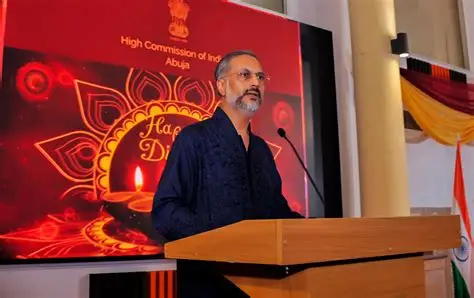
Bilateral trade between Nigeria and India rose by about 26 per cent to $9bn in the 2025-26 financial year from $7.13bn recorded in the preceding year, the Indian High Commissioner to Nigeria, Abishek Singh, has disclosed.
Singh, who made the disclosure at a media briefing in Abuja on Wednesday, also said more than 200 Indian companies operating in Nigeria had created close to 100,000 jobs for Nigerians, making them the second-largest employers of Nigerian workers after the Federal Government.
The High Commissioner said the growth in trade reflected the expanding strategic partnership between both countries, which he noted had moved beyond traditional oil and historical ties to encompass investment, security, technology, agriculture, healthcare, energy and other sectors.
“Very happy to report that the trade for the financial year 2025-26 stands at around US dollar 9 billion, which is up from US dollar 7.13 billion in the financial year 2024-25,” Singh said.
He said Indian companies in Nigeria were active in pharmaceuticals, manufacturing, power, construction, consumer goods, healthcare and services, adding that many had established production plants in the country.
“And this has translated into close to 100,000 brothers and sisters from Nigeria being deployed, employed by these companies.
For all breaking news and latest gist:
👉 JOIN GISTSMATE WHATSAPP CHANNEL“And that makes these Indian companies the second largest employer of Nigerian people after the Federal Government of Nigeria,” Singh said.
Singh said Nigeria and India had enjoyed longstanding relations rooted in anti-colonial solidarity, South-South cooperation and shared support for the voice of the Global South.
He recalled that India opened its Liaison Office in Lagos in 1958, two years before Nigeria gained independence, while the relationship was elevated to a Strategic Partnership during the visit of the then Indian Prime Minister to Nigeria in October 2007.
“When I say Strategic Partnership, what does it mean? It means that India-Nigeria relations are no longer defined only by historical goodwill or oil trade,” he said.
According to him, the partnership was evolving into a “multidimensional partnership” linking Nigeria, one of Africa’s largest economies, with India, one of the world’s leading powers.
Singh highlighted high-level political engagements between both countries, including President Bola Tinubu’s visit to India in September 2023 during India’s G20 presidency and Indian Prime Minister Narendra Modi’s state visit to Nigeria in November 2024.
He described Modi’s visit as historic, noting that it came after a gap of about 17 years and resulted in extensive discussions with Tinubu on trade and investment, defence, energy, agriculture, health, education, technology and security.
The High Commissioner also disclosed that India had extended concessional lines of credit worth $395m to Nigeria, alongside capacity-building programmes under the Indian Technical and Economic Cooperation programme.
He said the ITEC programme had provided training opportunities for Nigerians in areas ranging from auditing and teaching to rural development, electrification and defence.
On healthcare, Singh said India remained committed to strengthening cooperation with Nigeria, particularly in pharmaceuticals and affordable healthcare.
Also speaking, India’s Deputy High Commissioner to Nigeria, Vertika Rawat, said India supplied roughly 40 per cent of Nigeria’s pharmaceutical imports, with pharmaceutical exports to Nigeria reaching $315m in the 2024-25 financial year.
“India today supplies roughly 40% of Nigeria’s pharmaceutical imports, and for certain categories of medicine over 90%,” she said.
She added that Indian companies had invested about $4bn in pharmaceutical manufacturing in Nigeria.
“This is what it means in practice for India to be the pharmacy of the world. It means not only affordable medicines reaching Nigerian homes, but also manufacturing medicines in Nigeria for Nigerian homes,” Rawat said.
She said India’s experience in expanding health insurance coverage could offer useful lessons for Nigeria as the country pursued universal health coverage.
She added that India was witnessing significant improvements in maternal and child healthcare, financial inclusion and women’s empowerment.
Rawat said the country’s sixth National Family Health Survey covered 639,000 families across 707 districts, describing it as “the largest single-round household health survey ever undertaken anywhere in the world.”
She said antenatal care now reached 96 per cent of pregnant women, while institutional deliveries had risen to 90.6 per cent.
According to her, full immunisation among children aged 12 to 23 months increased from 83.8 per cent to 87.1 per cent, while household coverage under health insurance or financing schemes rose from 41 per cent to 60.2 per cent.
WARNING: If You Are Not 18+, Don’t Click The Link Below 👇🫣
Did you want to monetize your website, join MONETAG or ADSKEEPER and start earning
Please don’t forget to “Allow the notification” so you will be the first to get our gist when we publish it.
Drop your comment in the section below, and don’t forget to share the post.
Never Miss A Single News Or Gist, Kindly Join Us On WhatsApp Channel:
https://whatsapp.com/channel/0029Vad8g81Eawdsio6INn3B
Telegram Channel:
https://t.me/gistsmateNG