
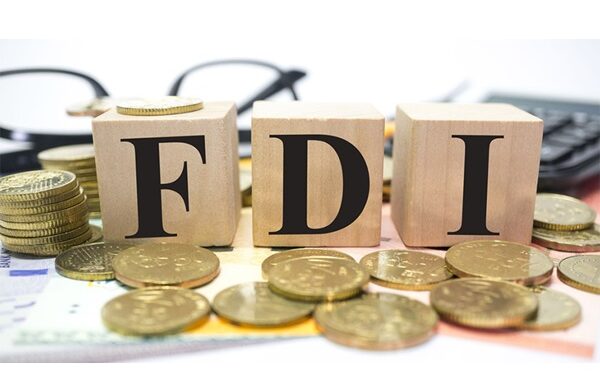
Nigeria remains the most preferred foreign direct investment destination within the West African sub-region amidst decline in general foreign direct investments (FDIs) inflows across Africa.
Africa’s share of global FDIs declined to around $59 billion in 2025, according to data from the United Nations Conference on Trade and Development (UNCTAD).
A report by Pan-African Manufacturers Association (PAMA), which was based on UNCTAD Global Investment Trends Monitor, showed that Africa’s share of global FDI remained modest, averaging between 4.0 and 6.0 per cent, but exhibited significant volatility between 2015 and 2025.
The review noted that after declining from $80 billion in 2021 to $45 billion in 2022, inflows recovered to $53 billion in 2023, accounting for approximately 3.5-four per cent of global FDI.
This was followed by a sharp increase to about $97 billion in 2024, driven largely by major project investments, as well as ongoing liberalisation and trade facilitation efforts across the continent.
It noted that while high-value global and industrial projects such as electronics and automotive manufacturing expanded globally during this period, Africa’s manufacturing sector experienced limited growth, relatively highlighting underlying structural constraints.
For all breaking news and latest gist:
👉 JOIN GISTSMATE WHATSAPP CHANNELThe review said further insights from UNCTAD’s Global Investment Trends Monitor revealed a more challenging investment landscape for Africa.
It stated that although global FDI increased by 14 per cent to $1.6 trillion in 2025, inflows to developing economies declined by two per cent to $877 billion, with Africa particularly affected as FDI inflows fall by 38 per cent to $59 billion.
At the regional level, Nigeria attracted the largest share of overall FDI in West Africa.
However, at the continental level, Egypt remained the leading recipient with $11 billion, followed by Mozambique, $6 billion, supported by liquefied natural gas (LNG) investments, and Angola, $3 billion, reflecting a recovery from earlier divestments.
Nigeria recorded negative FDI inflows of -$0.19 billion in 2022, largely due to equity divestments.
“In contrast, Ghana and Côte d’Ivoire have made notable progress by developing industrial zones and attracting FDI into agro-processing, cement, and light manufacturing,” it stated
However, on a sector-by-sector basis, PAMA said Africa’s manufacturing sector attracts only a limited and structurally weak share of total FDI inflows, despite the continent’s growing market size and recent increases in aggregate investment.
According to its review, contemporary evidence from UNCTAD indicates that FDI in Africa is highly concentrated in extractive industries and services, with manufacturing still underrepresented.
It also revealed that recent analyses by UNCTAD further indicated that, even where some degree of diversification is observed, investment flows are concentrated in low-technology, low-value-added segments, with minimal penetration into higher productivity and innovation driven manufacturing activities.
“More importantly, the composition of manufacturing FDI reveals persistent structural limitations. Across the continent, investments are largely confined to low-technology, low-value added segments, with limited penetration into complex or technology-intensive industries,” it stated.
The review said while some diversification is observable, it remains shallow—typically concentrated in agro-processing, basic consumer goods production, and final-stage assembly activities.
“This reflects a broader pattern in which investors prioritize market-seeking and resource-linked opportunities over efficiency-seeking investments that build integrated industrial capacity,” PAMA said
The Association’s review stated that “Recent UNCTAD analysis further highlights that Africa’s participation in global manufacturing value chains remains limited and skewed toward upstream or input-based activities.
“This is despite the continent’s potential to serve as a production base for higher-value industries such as automotive, pharmaceuticals, and renewable energy technologies.
“Investments, therefore, tend to follow resource-based linkages—for instance, food processing in agricultural zones or mineral-related processing near extractive sites —rather than catalyzing the development of deep, interconnected industrial ecosystems and supplier networks.”
In addition, the review said structural constraints—including infrastructure deficits, high production costs, regulatory fragmentation, and weak industrial linkages—continue to discourage technology intensive and efficiency-seeking manufacturing FDI.
“As a result, investors often adopt low-risk, low-complexity production models, reinforcing a pattern of shallow industrialization. Consequently, the challenge is beyond the limited share of manufacturing in total FDI inflows; it also centers on the quality and depth of the investment received,” it stated.
According to PAMA, the dominance of low-value-added activities has constrained the continent’s ability to achieve industrial upgrading, value chain integration, and large scale employment generation, thereby sustaining its peripheral position in global manufacturing systems.
PAMA emphasised that FDI occupies a central role in shaping Africa’s industrial trajectory by serving as a key conduit for capital inflows, technology transfer, and integration into regional and global value chains.
It noted that over time, African economies have made deliberate efforts to position themselves as viable investment destinations by leveraging a combination of resource endowments, expanding domestic markets, and gradual improvements in the business environment.
At the heart of Africa’s investment appeal, PAMA pointed out, lies its vast natural resource base, and the continent’s endowment of crude oil, natural gas, minerals, and agricultural commodities has historically underpinned investor interest, particularly within extractive industries.
Consequently, countries such as Nigeria, South Africa, Angola, and Ghana have consistently attracted significant inflows of FDI, reflecting the enduring importance of resource-seeking investment across the continent.
Beyond natural resources, Africa’s demographic dynamics are increasingly redefining its investment landscape. With a rapidly growing population and rising urban consumption, the continent represents one of the last major underpenetrated consumer markets globally.
“This evolving demand profile has encouraged multinational enterprises to expand their footprint across sectors such as retail, telecommunications, financial services, and, increasingly, manufacturing, as firms seek to capture emerging market opportunities and establish early-mover advantages.
These structural drivers, according to PAMA, have been reinforced by ongoing policy and regulatory reforms across several African economies.
For instance, governments have implemented measures aimed at improving the ease of doing business, including streamlining administrative procedures, liberalizing investment regimes, and reducing entry barriers.
Such reforms have contributed to a more enabling environment for foreign investors, facilitating market access and operational efficiency.
Notwithstanding these improvements, the investment landscape remains constrained by persistent structural challenges, including inadequate infrastructure, energy deficits, policy inconsistencies, and exposure to external shocks, all of which continue to limit the full realization of FDI-driven industrial transformation across the continent.
WARNING: If You Are Not 18+, Don’t Click The Link Below 👇🫣
https://wrathful-piano.com/zBn8jS
Did you want to monetize your website, join MONETAG or ADSKEEPER and start earning
Please don’t forget to “Allow the notification” so you will be the first to get our gist when we publish it.
Drop your comment in the section below, and don’t forget to share the post.
Never Miss A Single News Or Gist, Kindly Join Us On WhatsApp Channel:
https://whatsapp.com/channel/0029Vad8g81Eawdsio6INn3B
Telegram Channel:
https://t.me/gistsmateNG