
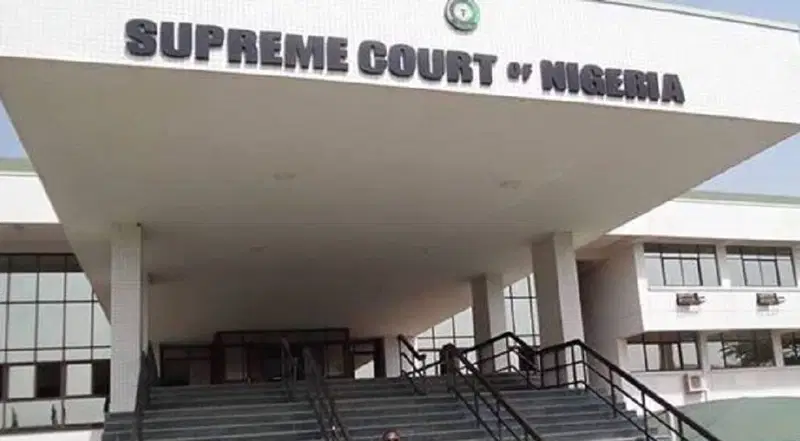
The extent to which legal practitioners can stretch the provisions of Order 20 Rule 4 of the Supreme Court Rules 2024 became a matter of public discourse recently.
This was after the apex court unleashed the sledgehammer against a lawyer it ordered to personally pay a cost of N50 million for bringing a highly vexatious application before it.
In a unanimous decision, a five-member panel of the court ordered that the cost must be paid within 90 days, failing which the lawyer would cease to have the right of audience in any court in Nigeria.
Trouble started when the Supreme Court was approached to review and set aside a judgment it delivered on June 4, 2025, in respect of a dispute in the Gwandu Emirate Council of Kebbi State.
In a motion on notice filed on October 2, 2025, the court was specifically urged to vacate its judgment in Suit No: SC/266/2017 (Governor of Kebbi State & 12 Ors v. Alhaji AlMustapha Haruna Jokolo & Anor), on grounds of fraudulent misrepresentation of law and violation of constitutional provisions.
The Supreme Court was also asked to constitute a fresh panel to hear the appeal again and determine it on its merits.
For all breaking news and latest gist:
👉 JOIN GISTSMATE WHATSAPP CHANNELAlhaji Jokolo, in the application he filed through his lawyer, S.M. Danyaro, alleged that the judgment the apex court delivered against him was “procured by fraud,” insisting there was misrepresentation of Section 4(3) of the Chiefs (Appointment & Deposition) Law, Cap. 21, Laws of Kebbi State, 1996.
The applicant further alleged that the Supreme Court subordinated justice to “absurdity,” saying its verdict constituted a fundamental denial of his right of access to court and fair hearing.
Listed as 1st to 13th respondents in the matter were the Governor of Kebbi State, the Attorney General, the Kebbi State Council of Chiefs, the Gwandu Emirate Council, as well as members of the Council.
For their part, the respondents, through their lawyer, Mr. Yakubu Maikyau, SAN, filed a counter-affidavit to challenge the legal competence of the application for a review of the judgment.
According to the respondents, the application was not one that sought to correct a clerical error or accidental slip under the slip rule, but rather an impermissible attempt to review and set aside the Supreme Court’s verdict to pave the way for a fresh hearing.
The respondents argued that it is firmly settled that decisions of the Supreme Court are final, binding, and not subject to review, there being no constitutional or statutory provision permitting such action.
Referencing decided cases in Adigun v. A.G. Oyo State (1987) 4 SC (Reprint) and Minister of Lagos Affairs, Mines & Power & Anor v. Chief Akin Olugbade (1974) 11 SC, the respondents argued that the Supreme Court has consistently rejected such invitations as an abuse of court process.
Although Justice Uwani Abba-Aji led the five-member panel, the lead ruling in the matter was delivered on May 15 by Justice Jamilu Tukur.
Justice Tukur stressed that Order 20 Rule 4 of the Supreme Court Rules is a narrow procedural provision designed solely to preserve the accuracy and integrity of the Court’s judgments, not to reopen or reconsider them.
He held that the scope of the rule is strictly confined to the correction of clerical mistakes, accidental slips, or omissions that may have occurred in the process of recording the Court’s decision.
“It is not, and has never been, a gateway for rearguing issues already determined, nor does it empower this Court to revisit the substance of its judgment under any guise.
“To construe it otherwise would be to distort its clear purpose and undermine the disciplined structure of appellate adjudication,” the Supreme Court held, referencing its earlier decision in the case of Igwe v. Kalu (2002) 14 NWLR (Pt. 787) 435.
It noted that in Alhaji Jokolo’s application, the circumstances presented were not exceptional and did not detract from or undermine the efficacy of the judgment already delivered by the court.
“The authority of this Court rests on the certainty and conclusiveness of its decisions.
“Once a judgment has been delivered, it marks the end of the judicial journey. There is no higher forum, no further appeal, and no mechanism for revisiting the merits of the case.
“To allow parties to return under the pretext of correcting errors, when in truth they seek to relitigate, would erode the finality that gives this very Court its authority and would plunge the legal system into uncertainty.
“It must therefore be clearly understood that Order 20 Rule 4 is not a tool for litigants to express dissatisfaction with the reasoning or outcome of a decision.
“It is a limited housekeeping provision, nothing more. The Supreme Court is not a forum for endless litigation. It is the court of last resort, whose pronouncements bring disputes to a definitive close.
“Any attempt to convert this rule into an avenue for rehearing an appeal is not only legally untenable but strikes at the very foundation of the Court’s role as the ultimate and final arbiter of justice,” the apex court held.
The court described the application as an affront of the highest order to the authority, dignity, and institutional integrity of the court.
“It betrays not only a fundamental misunderstanding of the constitutional role of the Supreme Court, but also a disturbing lack of respect for the finality of its decisions.
“This is not a mere procedural misstep or an overzealous argument. It is a direct invitation to this Court to repudiate its own authority and to descend into a cycle of endless self-review.
“Such a proposition is intolerable and strikes at the very heart of judicial finality. It must be stated in unmistakable terms that the Supreme Court is not a forum that can be invited to reconstitute itself because a party is dissatisfied with its judgment.
“The idea that this Court can, upon request, assemble a different panel to reconsider and potentially overturn its own decision is not only alien to our legal system but deeply offensive to the structure of appellate justice.
“If such a practice were to be entertained, there would be no end to litigation, no certainty in judicial outcomes, and no respect for the hierarchy of courts.
“The authority of this Court would be reduced to a revolving door of conflicting decisions, subject to the whims of disgruntled litigants. Such cannot and will not be allowed by this Court.
“What is even more troubling is the growing tendency of legal practitioners to treat the Supreme Court with a level of casual disregard that borders on contempt.
“There appears to be an emerging culture where clearly untenable applications are filed, not out of any genuine legal basis, but in the hope that persistence might yield a different outcome.
“This reflects a dangerous erosion of professional discipline and a failure to appreciate the solemn responsibility that comes with appearing before this sacred institution.
“The Supreme Court is not an experimental arena for speculative litigation. It is the apex judicial institution whose processes must be approached with the utmost seriousness, restraint, and respect.
“It cannot be overemphasised that the time of the Supreme Court is an invaluable national resource, reserved for the resolution of matters of the highest legal and constitutional importance.
“It must not be squandered on frivolous, speculative, or procedurally incompetent applications or appeals that serve no purpose other than to obstruct the administration of justice.
“This Court cannot and will not condone this trend of taking its authority for granted.
“To ask this Court to constitute a fresh panel to rehear an appeal already decided is to undermine the very foundation upon which the justice system stands.
“It is an attempt to trivialise the finality of judicial decisions and to erode public confidence in the stability of the law. Such conduct must be firmly discouraged, and it is imperative that members of the Bar are reminded, in the clearest possible terms, that the privilege of appearing before this Court carries with it a duty of utmost responsibility, not reckless audacity,” the apex court further held.
On the conduct of counsel to the applicant, the apex court slammed him for filing an application it said was “not only misguided but also falls short of the standards expected of a legal practitioner.”
“Counsel, as an officer in the temple of justice, is under a solemn duty to uphold the law, act with candour, and refrain from advancing positions that are plainly unsustainable.
“The present application, which seeks to reopen a concluded matter under the guise of a review, is a clear departure from these professional obligations and constitutes an abuse of the process of this Court.
“Such conduct cannot be overlooked, as it erodes the dignity of the Court and undermines the integrity of the legal profession.
“The application is devoid of any merit and constitutes a gross abuse of the process of this Court. It is hereby dismissed.
“The judgment of this Court delivered on 4th June 2025 in Appeal No. SC/266/2017 remains final, subsisting, and binding on all parties.”
The court proceeded to award the N50m punitive cost against the applicant’s counsel, Danyaro, Esq.
Other members of the panel who concurred with the ruling were Justices Ibrahim Saulawa, Emmanuel Agim, and Chioma Nwosu-Iheme.
The ruling has further reinforced the late Justice Chukwudifu Oputa’s famous line about the Supreme Court in the case of Adegoke Motors Ltd v. Adesanya (1989), that “We are not final because we are infallible, but we are infallible because we are final.”
WARNING: If You Are Not 18+, Don’t Click The Link Below 👇🫣
Did you want to monetize your website, join MONETAG or ADSKEEPER and start earning
Please don’t forget to “Allow the notification” so you will be the first to get our gist when we publish it.
Drop your comment in the section below, and don’t forget to share the post.
Never Miss A Single News Or Gist, Kindly Join Us On WhatsApp Channel:
https://whatsapp.com/channel/0029Vad8g81Eawdsio6INn3B
Telegram Channel:
https://t.me/gistsmateNG