
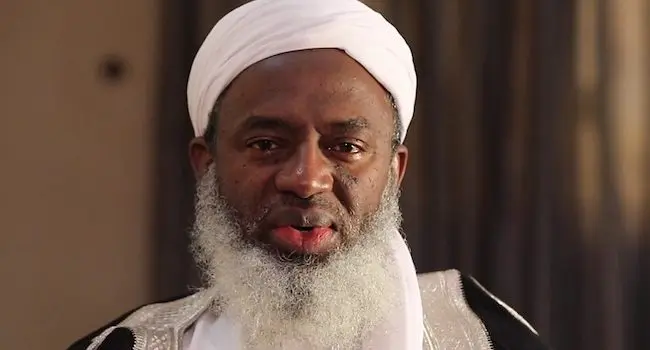
Controversial Islamic cleric, Sheikh Ahmad Gumi, has called on the Nigerian government to open a six-month amnesty window for terrorists and bandits to surrender their weapons, arguing that negotiation is necessary to end the country’s worsening insecurity.
Gumi made the call in a video circulating online, in which he discussed Nigeria’s security crisis and questioned the government’s reliance on military action against armed groups.
“Why can’t we negotiate with them? If I’m the president, I will announce that I’m giving a six-month amnesty window for all the terrorists and bandits to put down their weapons,” Gumi said.
The cleric argued that the Federal Government should treat insecurity as a domestic problem and develop its own approach rather than relying on what he described as international standards on negotiations with armed groups.
He cited negotiations involving countries and groups such as the Taliban and Hamas as examples of situations where governments have engaged their adversaries despite describing them as terrorists.
“You negotiate. You negotiate with Taliban, you negotiate with Hamas, you negotiate with everybody where you have problems. Why can’t we negotiate with them?” he said.
Follow us for breaking news:
👉 JOIN WHATSAPP CHANNELGumi also argued that the government should combine any amnesty programme with education and economic opportunities for the armed groups and their children.
“Most important, when you do that, entice their children to education. Build schools for them,” he said.
He suggested that schools could be established within communities where the affected populations live as part of a broader strategy to encourage them to abandon violence.
The cleric further argued that funds being spent on military hardware could instead be deployed to address the socio-economic conditions he believes contribute to insecurity.
He referred to the reported $5 million cost of an aircraft, arguing that such money could be used to provide livelihoods and keep potential recruits occupied.
“Let me tell you, $5 million, keeping a lot of them busy after the rehabilitation with cows would have gone a long way to end insecurity in Nigeria,” he said.
Gumi Recalls Obasanjo’s 2011 Boko Haram Contact
Gumi also referred to a previous attempt by former President Olusegun Obasanjo to establish contact with Boko Haram members, saying the former president had personally travelled to Maiduguri, Borno State, during the early years of the insurgency.
“General President Obasanjo told me himself, at the early stage of Boko Haram, he went to Maiduguri himself, met with leaders of Boko Haram. They agreed to lay down their arms,” Gumi said.
According to him, Obasanjo returned from the meeting but the government was reluctant to act on the understanding.
“He came back, the government was reluctant to take action, and he was bitter about that,” Gumi added.
Obasanjo’s meeting involved members of the family of the late Boko Haram founder, Mohammed Yusuf, and other figures associated with the insurgency. The group reportedly presented demands including an end to arrests and killings of its members and prosecution of police officers accused of killing Yusuf.
Obasanjo later said in 2016 that he had visited Maiduguri in 2011 to initiate a dialogue process aimed at persuading insurgents to lay down their arms.
Gumi’s latest comments are consistent with his long-standing position that Nigeria should negotiate with armed groups rather than rely exclusively on military operations.
In February 2021, Gumi called on the Federal Government to grant bandits who were willing to make peace “blanket amnesty,” following his visits to bandits’ camps in parts of northwestern Nigeria.
A month later, he said the bandits he had met were willing to negotiate and be reintegrated into society, arguing that the government needed to assure them of their safety before they would surrender their weapons.
Gumi also argued that education, healthcare and registration of former bandits would make it easier for the government to monitor and reintegrate them.
“When you offer them amnesty, they drop their weapons. Then you go in, build schools for them, build hospitals for them, get them censored; get them registered; then you can control them,” he said in an earlier interview.
His position has repeatedly attracted criticism from political leaders and Nigerians who argue that granting amnesty to armed groups responsible for killings, kidnappings and other crimes could encourage further violence.
In 2021, then Kaduna State Governor Nasir El-Rufai rejected Gumi’s proposal and said his administration would not negotiate with bandits.
Gumi has nevertheless continued to defend dialogue as an option for resolving Nigeria’s insecurity crisis.
In 2022, he spoke at a peace-building symposium in Maiduguri focused on reintegrating former Boko Haram insurgents, where he linked insecurity to poverty, unemployment and lack of education.
WARNING: If You Are Not 18+, Don’t Click The Link Below 👇🫣
Did you want to monetize your website, join MONETAG or ADSKEEPER and start earning
Please don’t forget to “Allow the notification” so you will be the first to get our gist when we publish it.
Drop your comment in the section below, and don’t forget to share the post.
Never Miss A Single News Or Gist, Kindly Join Us On WhatsApp Channel:
https://whatsapp.com/channel/0029Vad8g81Eawdsio6INn3B
Telegram Channel:
https://t.me/gistsmateNG