
There is a particular kind of Nigerian story that does not make the front pages, and yet it tells us more about where this country is going than any economic forecast ever could.
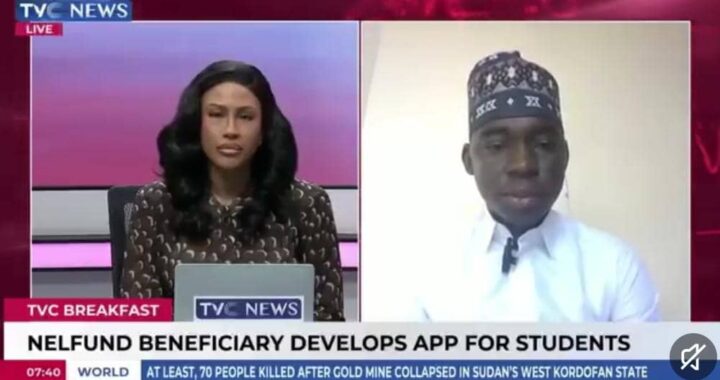
It is the story of a young person who receives help, and instead of merely being grateful, asks what more can be done and then goes out and does it. That is the story of Abdullahi Adam Usman, a 300 level International Studies student at Ahmadu Bello University, Zaria, and a beneficiary of the Nigerian Education Loan Fund, who has developed an independent mobile application designed to simplify and clarify the NELFUND process for students and parents alike.
I first encountered this development with the mixture of surprise and deep satisfaction that comes when the very people a policy was designed to serve turn around and strengthen it with their own hands. It deserves to be celebrated, and it deserves to be understood.
Let us be honest about the problem Abdullahi set out to solve. NELFUND is, by any measure, one of the most consequential interventions in Nigerian education in a generation over ₦355 billion disbursed, more than 1.6 million beneficiaries, and a target of seven million students. But scale brings complexity.
For a first generation applicant, the process can feel intimidating: what documents are required, how does the institutional charge differ from the upkeep allowance, what does pending mean on the portal, when should an alert be expected, and what does a parent do when they cannot tell whether their child’s application has been approved or merely submitted? These are not failures of policy; they are the natural frictions of any large system. And friction, left unattended, breeds doubt the kind of doubt that makes a poor family in Kano or Ekiti hesitate to even try. Abdullahi looked at that friction and saw an opportunity to serve.
What makes this achievement remarkable is not simply the technology. It is the discipline behind it. Abdullahi is not a computer science student. He is an International Studies undergraduate, which means every line of code, every interface decision, and every attempt to make the application intuitive was the product of self teaching, curiosity, and persistence.
For all breaking news and latest gist:
👉 JOIN GISTSMATE WHATSAPP CHANNELHe did not wait for a curriculum to legitimise his ambition, nor for a salary to justify his effort. He identified a problem that had affected him personally as a beneficiary, and he converted that experience into a tool that could help thousands who will never meet him. In a country where we often speak of young people as a demographic to be managed, Abdullahi reminds us that they are, in fact, a resource to be unleashed.
I want to be careful, however, not to reduce this to a feel good anecdote. There is a serious lesson here for governance, and this administration is listening. President Bola Ahmed Tinubu has consistently argued that the state cannot and should not be the sole engine of national problem solving. The most dynamic economies in the world are those where citizens, especially young citizens, build alongside government rather than waiting passively for it.
An innovation like Abdullahi’s a simple, accessible tool that explains a government process in plain language is precisely the kind of complementary solution that makes public policy work better on the ground. It does not replace NELFUND; it extends its reach into the places where information is scarcest and where a single clarifying guide can mean the difference between a student applying and a student abandoning hope.
This is also why the administration’s broader vision matters here. The engagements at the 81st United Nations General Assembly, which have progressed from a $1 billion proposition to a Memorandum of Understanding for an Innovation Hub and an Innovation Grid with a projected annual value of about $10 billion, are not abstract exercises. They are an attempt to build an ecosystem in which young Nigerians like Abdullahi do not have to work in isolation, coding at night with unstable power and no mentorship, but can plug into structured support, funding, incubation, and markets. Abdullahi is, in a very real sense, the kind of talent that Grid is designed to serve. His app is not a novelty; it is a signal of what becomes possible when raw ability meets even a small opening.
I must also speak to the officials and institutions within the education and technology space. A student has done the work of identifying a pain point and building a response. The responsible thing now is not to feel threatened by it, nor to ignore it, but to engage it seriously.
I will be recommending that NELFUND’s management, along with relevant agencies in the digital economy space, take a close and respectful look at what Abdullahi has built not to absorb it without credit, but to consider how such citizen led innovation can be supported, refined, and where appropriate, amplified. Government should be humble enough to learn from the people it serves, and confident enough to partner with them.
To Nigerian students across the country, Abdullahi’s example carries a challenge that no amount of national rhetoric can substitute for. You do not need to wait until graduation, or until you have a title, or until someone gives you permission to be useful. You have a phone, you have a problem you understand better than any consultant in Abuja, and you have the programmes this administration has provided the Three Million Technical Talent initiative, the digital literacy schemes, the training opportunities now reaching campuses. Abdullahi did not complain that the process was unclear; he made it clearer. That posture, multiplied across two million students, would change this country faster than any single policy could.
Let me end with a word directed personally to Abdullahi Adam Usman. What you have done is more than a technical accomplishment; it is an act of citizenship. You received a loan from a system you did not design, and you responded by improving that system for those who come after you. That instinct to build rather than to merely benefit is the instinct of a generation that will not be defined by what Nigeria failed to give it, but by what it chose to create in spite of everything.
On behalf of this administration, I commend you. I urge you to keep refining, keep learning, and keep building. And I want you to know that this government, and this office, is watching your progress with genuine pride not because you praised anyone, but because you worked. That is the Nigeria we are trying to build. One where a student in Zaria can quietly solve a national problem, and where the country has the wisdom to notice.
Hon. Asefon Sunday Dayo
Senior Special Assistant to the President on Students Engagement.
WARNING: If You Are Not 18+, Don’t Click The Link Below 👇🫣
Did you want to monetize your website, join MONETAG or ADSKEEPER and start earning
Please don’t forget to “Allow the notification” so you will be the first to get our gist when we publish it.
Drop your comment in the section below, and don’t forget to share the post.
Never Miss A Single News Or Gist, Kindly Join Us On WhatsApp Channel:
https://whatsapp.com/channel/0029Vad8g81Eawdsio6INn3B
Telegram Channel:
https://t.me/gistsmateNG