
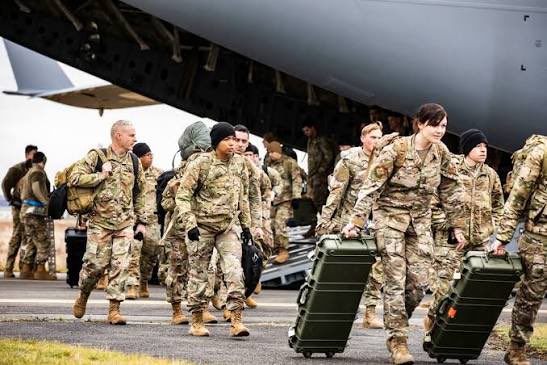
The United States has withdrawn most of the military personnel it deployed to Nigeria for a joint counterterrorism operation in the Lake Chad Basin.
The Commander of the US Air Forces in Europe–Air Forces Africa, General Dagvin R.M. Anderson, disclosed this during a press briefing on the outcome of the African Chiefs of Defence Conference 2026.
The United States deployed about 200 military personnel to Nigeria in February to support intelligence, surveillance and counterterrorism operations in the Lake Chad Basin.
The deployment formed part of growing security cooperation between Washington and Abuja in the fight against ISIS and other terrorist groups operating in the region.
It followed the redesignation of Nigeria as a Country of Particular Concern by US President Donald Trump, who pledged to strengthen US support for efforts to combat terrorist groups operating in the country.
On 25 December 2025, the US carried out air strikes on two terrorist enclaves in the Bauni Forest, located in Tangaza Local Government Area of Sokoto State.
The partnership later culminated in the killing of Abu-Bilal Al-Minuki, the second-in-command of ISIS, at his hideout in Borno State.
Speaking at the conference, Anderson highlighted the role of US-Nigeria intelligence cooperation in counterterrorism operations against the Islamic State (ISIS/Daesh).
He said the operation in the Lake Chad Basin had concluded and that most of the US personnel involved had returned to Washington, DC.
“And so that operation in the Lake Chad Basin of Nigeria not only helped the countries in that immediate region, but it also helps countries globally, as that disrupts the ISIS network.
“And so — and then we have withdrawn much of our forces that were just there for that operation, but are continuing the partnership that Nigeria has asked for to help continue with the intelligence sharing and the understanding that’s necessary to be able to prosecute these difficult tasks,” he said.
The US general described Nigeria as a capable partner with a strong military, noting that cooperation between the two countries had produced significant gains in the fight against ISIS.
According to him, US intelligence support, combined with the efforts of the Nigerian military, led to the successful operation that eliminated the second-in-command of the ISIS global network.
“I think the partnership that we’ve shown recently with Nigeria, where Nigeria’s a very capable and large country — it’s got a strong economy; it’s got a large, educated population; it’s got a very capable military.
“But there are things that we have learned in the counterterrorist fight over several years that we were able to assist and integrate with them to help them with their intelligence and help with the intelligence sharing that eventually led to a cooperative effort to where we were able to bring some unique capabilities that the U.S. brings and be able to prosecute together the number two leader within the ISIS or Daesh organisation who is responsible for much of their global operations, their global media, and their recruiting.
“So I think as we go forward, that is an example of how we’re looking at engaging with partners to help them be more effective by only bringing unique U.S. capabilities that allow the partner to be effective in these fights,” he said.
Anderson also called for stronger intelligence-sharing among African countries to combat terrorism, illicit trafficking and other transnational crimes.
He said effective communication and established partnerships had recently contributed to the interception of a record 31-tonne cocaine shipment originating from South America and transiting along the West African coast.
“I was able to coordinate through our interagency in the United States, through AFRICOM, and then notify some of the partners. And eventually it was a Spanish ship that interdicted the ship that had 31 tonnes of cocaine on it, and it turns out to be the largest interdiction of drugs at sea that we’ve ever seen,” Anderson said.
He added that sustained cooperation among African countries, international partners and the private sector would remain crucial to tackling security threats while promoting economic stability and investment across the continent.
WARNING: If You Are Not 18+, Don’t Click The Link Below 👇🫣
Did you want to monetize your website, join MONETAG or ADSKEEPER and start earning
Please don’t forget to “Allow the notification” so you will be the first to get our gist when we publish it.
Drop your comment in the section below, and don’t forget to share the post.
Never Miss A Single News Or Gist, Kindly Join Us On WhatsApp Channel:
https://whatsapp.com/channel/0029Vad8g81Eawdsio6INn3B
Telegram Channel:
https://t.me/gistsmateNG