
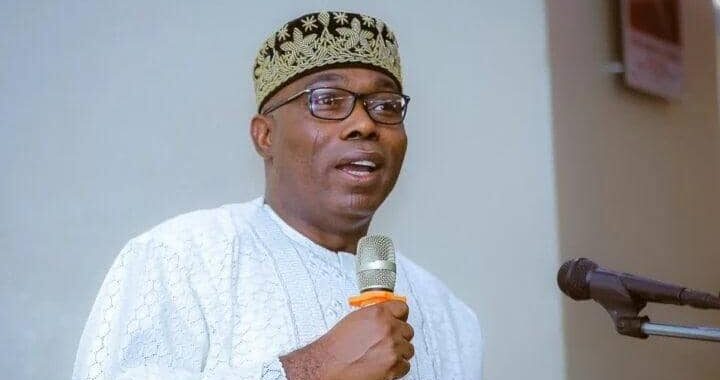
Social Democratic Party (SDP) presidential candidate Adewole Adebayo has said corrupt public officials who steal funds meant for essential services should face execution, arguing that if armed robbers can be killed for taking one life, officials who divert public resources and cause widespread deaths should face the same punishment.
Adebayo made the statement in an interview with SYMFONI TV watched by SaharaReporters, while speaking on Nigeria’s insecurity, corruption and the need to reform the country’s security architecture ahead of the 2027 presidential election.
Asked whether he supported capital punishment for certain crimes, Adebayo said: “Yes, especially corruption.”
He argued that the consequences of corruption could be more devastating than those of conventional violent crimes because the diversion of public funds can deprive thousands of people of healthcare, infrastructure and other essential services.
“A person who shoots, or using a knife to stab one person, kill one person,” Adebayo said. “A person who mismanages hospital funds kills thousands.”
He questioned why an armed robber who kills one person should face execution while a public official who diverts money meant for hospitals, roads and other public services should not face equally severe punishment.
For all breaking news and latest gist:
👉 JOIN GISTSMATE WHATSAPP CHANNEL“So, if you are going to shoot an armed robber who shot one person in front of a bank, why will you not shoot somebody who is running away with the money that is meant to run a hospital, road, and all of that?” he asked.
Adebayo said his proposed justice principle would apply particularly to people who deliberately take human life, but stressed that the judicial process must protect innocent people from wrongful conviction.
“Let me tell you my justice principle: If you willingly take human life, you don’t deserve your own,” he said. “But we’ll make sure that the judiciary is fair, and that no innocent person is convicted,” he added.
The SDP candidate extended the position to terrorism, insurgency, kidnapping and banditry, describing offences involving the deliberate taking of human life as deserving of the ultimate penalty.
On insecurity, Adebayo attributed the persistence of criminality in Nigeria to what he described as political interference and corruption within the government and law-enforcement system.
“Insecurity is a government programme,” he said.
Adebayo argued that Nigeria’s security agencies have the capacity to fight crime but are constrained by the chain of command and political authority.
“Our soldiers are patriots. Officers, men, some officers are bad and we are kicking them out,” he said. “Our police are fantastic. But they have one problem: they only obey orders.”
He illustrated his argument with a hypothetical situation in which police officers arrest suspected criminals but are subsequently ordered by a superior officer to release them.
“If you gather 10 people at Eagle Square, and shoot them in the head, and a police sergeant leads five constables and arrests you there, if the Commissioner of Police says, ‘Leave them alone,’ what will the policeman do? Disobey?” he asked.
“That is the fault there,” he said.
According to Adebayo, Nigeria’s security problems cannot be sustainably addressed unless political leadership is subject to the same laws that security agencies are expected to enforce.
“So, our system must put at the apex a law-abiding citizen,” he said. “When you put a criminal at the apex, law enforcement can never work, because the way law enforcement is designed is that they must listen to civilian authority or final authority. And if final authority is a criminal, the system will be criminalised.”
He further argued that security reports could reveal links between criminal activities and people close to political office holders if the government genuinely ordered security agencies to pursue all criminals without interference.
“If you say today, government says to the police, ‘Wipe out all criminals,’ the first thing they will do is to bring a security report and come and tell you, ‘Oga, you said we should kill or arrest all criminals. Your junior brother is there, oh. Your son is actually the one selling the weed. Your wife is a cocaine distributor. Should we still go ahead or not?’” he said.
Adebayo said restoring integrity in public office is therefore central to addressing insecurity.
“So, we will restore honour and dignity in government,” he said.
On the debate over state police, Adebayo said he supports allowing states to establish and control police forces, arguing that governments capable of making and enforcing laws should also have policing powers.
“I believe that every level of government that is capable of making laws should be capable of policing that law,” he said. “If a state can run its assembly, and pass a law that if you kill somebody, you shall be killed; they should be able to apprehend you when you kill somebody.”
He added: “And if they can run a court… We can trust the state to run courts that can sentence somebody to death, why can we not run state police?”
Adebayo also argued that public service should be treated as a voluntary responsibility that carries strict ethical obligations.
“If you know that you are not capable of living to the code of conduct, don’t take a government job,” he said. “It’s not compulsory.”
“But if you do, come and commit corruption under government, your family who came for your inauguration swearing-in will see you tied and shot in public,” he added.
WARNING: If You Are Not 18+, Don’t Click The Link Below 👇🫣
Did you want to monetize your website, join MONETAG or ADSKEEPER and start earning
Please don’t forget to “Allow the notification” so you will be the first to get our gist when we publish it.
Drop your comment in the section below, and don’t forget to share the post.
Never Miss A Single News Or Gist, Kindly Join Us On WhatsApp Channel:
https://whatsapp.com/channel/0029Vad8g81Eawdsio6INn3B
Telegram Channel:
https://t.me/gistsmateNG