
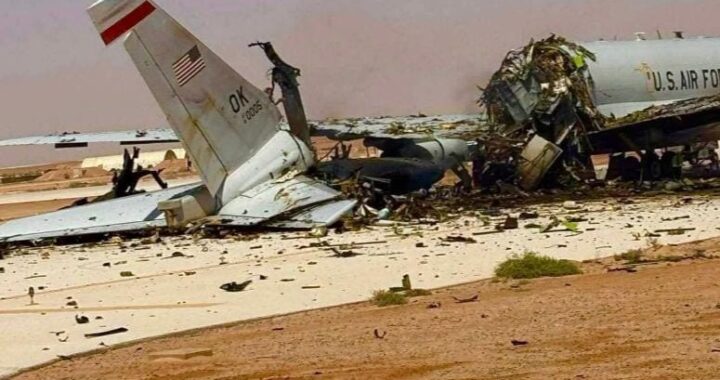
A pivotal U.S. Air Force E-3 Sentry AWACS command and control plane was among the aircraft damaged in a March 27 Iranian missile and drone attack on Prince Sultan Air Base, Saudi Arabia, people familiar with the matter told Air & Space Forces Magazine.
The attack injured more than 10 service members, two seriously. Among the other planes damaged are aerial refueling tankers.
U.S. Central Command has declined to comment on the incident.
Air & Space Forces Magazine has reviewed an image that shows significant damage to an E-3 at Prince Sultan Air Base. The image appears to show one of the E-3s stationed at the Saudi base, based on runway signage and aircraft markings. If confirmed, the extent of the damage to the aging aircraft likely renders it unrepairable.
Six E-3s had been stationed at Prince Sultan Air Base before the incident, according to open-source flight tracking data. Air & Space Forces Magazine previously reported that a USAF E-3 and tankers were damaged in the March 27 Iranian attack.
The AWACS has a storied history and has helped manage the battlefield in major conflicts. The Air Force has flown AWACS planes since the late 1970s to provide command and control and intelligence, surveillance, and reconnaissance capabilities. They have been used extensively in Operation Desert Storm, the Kosovo war, the wars in Iraq and Afghanistan, and the counter-Islamic State campaign known as Operation Inherent Resolve.
But the E-3 is aging, and its capabilities are falling behind those of some major adversaries. The Air Force’s E-3 fleet has dwindled down to 16 as the service retires less-capable planes. In fiscal 2024, E-3s had a mission-capable rate of about 56 percent, meaning a little more than half were able to fly and carry out their missions at any given time.
Losing one of its increasingly rare AWACS—especially one that was apparently being actively used in current operations—could hamper the Air Force’s ability to manage battlefields, airpower experts said.
“The loss of this E-3 is incredibly problematic, given how crucial these battle managers are to everything from airspace deconfliction, aircraft deconfliction, targeting, and providing other lethal effects that the entire force needs for the battle space,” said Heather Penney, a former F-16 pilot and director of studies and research at AFA’s Mitchell Institute for Aerospace Studies.
Experts said losing this E-3 could create gaps in the Air Force’s battlespace awareness and management, and could lead to missed opportunities to target Iranian forces.
“It’s a significant loss for the war in the short term,” said Kelly Grieco, a defense policy expert and senior fellow at the Stimson Center. “That has a consequence. There are going to be coverage gaps.”
Fighter pilots especially rely on the battlespace picture provided by the AWACS, added Penney.
“The value of the E-3 and the battle managers is they see the big picture,” Penney said. “They’re the chessmaster, while [fighter pilots] are the bishops.”
CENTCOM commander Adm. Brad Cooper said March 25 that Iranian missile and drone launches were down by more than 90 percent since the start of the conflict on Feb. 28.
But Iran remains capable of launching missiles, as this episode shows, and continues to attack key U.S. bases and targets across the region, even with diminishing assets. It has appeared to focus on radar sites and other targets, such as tankers and AWACS aircraft, that could impact America’s ability to project airpower.
Prince Sultan Air Base is an important U.S. military hub in the Middle East and hosts an array of aircraft supporting operations against Iran.
“It’s certainly not random,” Grieco said. Iran, by attacking radars, communications sites, aircraft, and bases, appears to be attempting to conduct an “asymmetric counter air campaign,” she added.
“It seems like it is a deliberate campaign to go after the critical enablers of U.S. airpower,” Grieco said.
Experts said the loss of this AWACS will stretch the handful of remaining E-3s even further, and could lead to shortfalls in the Air Force’s battle management coverage in the Middle East. The U.S. will also face a dwindling and stressed E-3 fleet after the conflict.
Pentagon leadership has expressed skepticism about acquiring the proposed replacement for the E-3, the E-7 Wedgetail, and voiced support for relying more on space-based systems instead.
“We’ve simply taken too much risk in the battle management career field, both with the battle managers and with the airframes,” Penney said. “Space will be an incredible capability, but it is not here today. And this is an example of how we don’t always get to pick the timelines of conflict, so we can’t wait for future capabilities that are not in the force today.
“The E-7 is desperately needed to replace the E-3, and the strain that the loss of this E-3 will impose upon not just the career field, but the capabilities, the battle managers, and how that then ripples across the effectiveness in the entire force, underscores the need to accelerate the procurement and delivery of the E-7,” Penney continued.
Over 300 service members have been wounded so far in Operation Epic Fury, according to U.S. officials. Thirteen service members have been killed, including a Soldier at Prince Sultan Air Base during a previous attack on the base in early March. The U.S. has also had roughly 20 aircraft damaged during the air war.
Three F-15E Strike Eagles were shot down by a Kuwaiti fighter in a friendly fire incident March 2, Air & Space Forces Magazine previously reported. All crew members were recovered safely.
On March 12, a KC-135 Stratotanker crashed in western Iraq, killing all six Airmen aboard.
Another KC-135 had its tail severely damaged in the same incident but landed safely. In a March 14 social media post, President Donald Trump appeared to confirm that at least one KC-135 was damaged on the ground by an Iranian strike on Saudi Arabia.
At least a dozen MQ-9 Reaper drones have been lost in the conflict, and some of the losses occurred while the aircraft were on the ground during Iranian missile attacks. A USAF F-35 Lightning II was damaged over Iran on March 19.
Losing this E-3 will place an even greater burden on the remaining AWACS, Penney said, and potentially burn them out faster.
“It further strains the force, and because we have not invested in battle management aircraft for decades, we’re reaping what we sowed,” Penney said.
WARNING: If You Are Not 18+, Don’t Click The Link Below 👇🫣
https://emitprocured.com/u36k6hvh?key=9d5a995551042f49ca200d04746b52ad
Did you want to monetize your website, join MONETAG or ADSKEEPER and start earning
Please don’t forget to “Allow the notification” so you will be the first to get our gist when we publish it.
Drop your comment in the section below, and don’t forget to share the post.
Never Miss A Single News Or Gist, Kindly Join Us On WhatsApp Channel:
https://whatsapp.com/channel/0029Vad8g81Eawdsio6INn3B
Telegram Channel:
https://t.me/gistsmateNG