
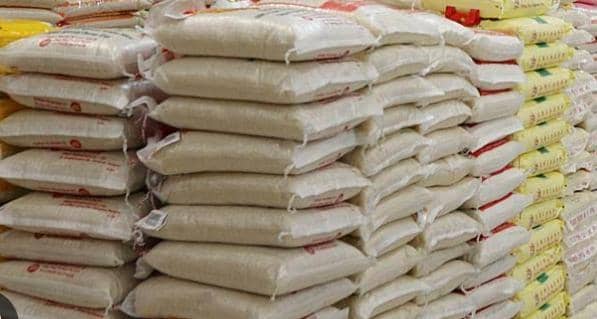
Rice prices have dropped sharply in several Lagos markets due to a surge in border imports, easing the burden on consumers.
The development, however, has raised concern among traders over reduced profits and business sustainability.
The News Agency of Nigeria (NAN) reports that 50kg of rice in Lagos currently sells for between N55,000 and N70,000, depending on the brand.
The traders and consumers who spoke with NAN in separate interviews in Lagos disclosed that the stable food has suddenly experienced a price crash.
They noted that both local and foreign rice brands have seen a steep price drop, reversing the surge seen earlier in the year.
In popular markets such as Oyingbo, Arena (Oshodi), Festac Town, and Mile 12, a 50kg bag of local rice that sold for around ₦85,000 in January now goes for between ₦60,000 and ₦70,000.
Similarly, foreign rice, which was ₦95,000 at the beginning of the year, currently sells for between ₦65,000 and ₦75,000, depending on the brands and market location.
At the Arena Market, Mrs Precious Okoro, a rice dealer, lamented that the recent crash had left many traders struggling to recover their investments.
“We are selling at a loss. I bought several bags at ₦80,000 and ₦85,000 early this year, and now I have to sell them for as low as ₦65,000. The fall came suddenly, and it’s been tough for us,” Okoro said.
She added that while customers are excited about the new prices, traders are counting heavy losses.
“Rice doesn’t spoil easily like other food items, but when prices crash this way, our capital just ties down. Some of us can’t even restock,” she said.
Okoro said the government needed to be intentional in stabilising rice prices in the country by providing regular support to local farmers to boost the supply chain.
“The government needs to provide incentives for local farmers to increase production and improve the infrastructure for storage and distribution.
“This will help to reduce the cost of production and make rice more affordable for consumers,” Okoro said.
At the FESTAC Town Market, a retailer, Mrs Edith Nwaruh, said a 50kg bag of Pretty Lady rice sold for ₦57,000, Mama Africa for ₦62,000, Mama Gold for ₦67,000, and Big Bull Premium for ₦73,000.
Nwaruh said the decline began around August, following reports of improved local harvests and increased rice supply from northern states.
“We have more rice in the market now. Local production improved, and imports also increased. When there’s too much supply, prices must drop,” she said.
Another trader at the Mile 12 Market, Mr Odion Michael, described the situation as a “double-edged sword.”
“Consumers are happy, but traders are weeping. We want prices to be stable, not jumping or falling suddenly. Price stability helps us to plan our business,” he said.
However, a rice farmer and stakeholder who pleaded anonymity attributed the price drop to the reopening of land borders, which has allowed an increased inflow of rice from neighbouring rice-producing countries.
He disclosed that the development had flooded the market with both imported and locally produced rice, leading to a temporary price decline.
He, however, cautioned that the decline might not be sustainable, warning that prices could surge again before December due to market instability and fluctuating supply levels.
A trader at the Oyingbo Market, Mr Ben Chidi, attributed the development to improved supply and reduced market stockpiles.
He said that the government’s renewed support for local farmers and improved distribution channels contributed to the glut.
This, he said, ensured that consumers were relieved.
Mrs Andriana Okoromaro, a consumer, said the drop was timely given the high cost of other food items.
“At least, rice is affordable again. I used to buy a half bag because it was too expensive. Now, I can buy a full bag for the family. It’s a big relief,” she said.
Another consumer, Mrs Oluwaseun Alade, said she hoped prices would remain low during the festive season.
“Rice is essential during Christmas and New Year. This drop if sustained means more families can celebrate without worry,” she said.
Mrs Ngozi Okolie, a consumer, said the fall is not only linked to increased supply but also to reduced purchasing power among Nigerians, which has lowered demand.
“People don’t have much money, even with lower prices. The economy is slow, so even when goods are cheap, sales are not what they used to be,” she added.
WARNING: If You Are Not 18+, Don’t Click The Link Below 👇🫣
https://rayvirtual.com/m3e85u39j?key=f0014e9d9438d5115e4d66e73ca3f04b
Please don’t forget to “Allow the notification” so you will be the first to get our gist when we publish it.
Drop your comment in the section below, and don’t forget to share the post.
Never Miss A Single News Or Gist, Kindly Join Us On WhatsApp Channel:
https://whatsapp.com/channel/0029Vad8g81Eawdsio6INn3B
Telegram Channel:
https://t.me/gistsmateNG