The Nigerian government has introduced a new curriculum for schools that mandates Junior Secondary School (JSS 1) students to pick at least one trade subject to boost practical skills.
According to a document developed by the Nigerian Education Research and Development Council (NERDC), the six practical skills available are Solar Photovoltaic installation and maintenance, Fashion design and garment making, Livestock farming, Beauty and cosmetology, Computer hardware and GSM repairs, Horticulture and crop production.
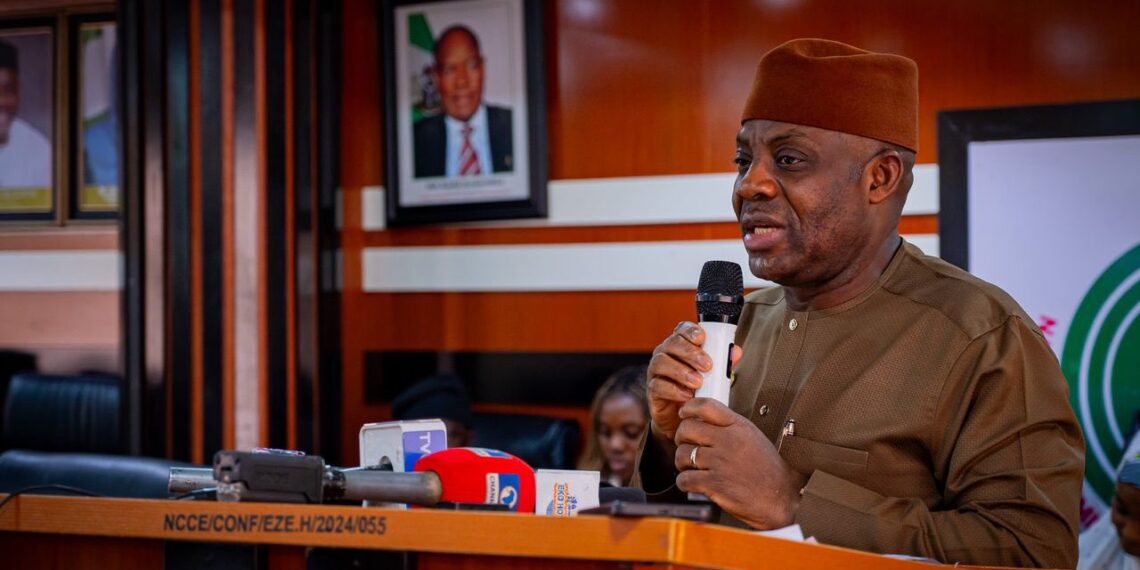
Speaking at the 2025 International Conference of the African Curriculum Association hosted by the NERDC on Monday, the Minister of Education, Tunji Alausa, described the new curriculum as ‘future-ready’ and noted it was streamlined to meet the skills demand of the 21st century.
Represented by the Minister of State for Education, Suwaiba Ahmad, a professor, Mr Alausa said the review for the basic education level has been completed, while that of the senior secondary level nears completion.
A separate statement by the education ministry’s spokesperson, Folasade Boriowo, indicated that the review was conducted in collaboration with the NERDC, the Universal Basic Education Commission (UBEC), National Secondary School Education Commission (NSSEC), National Board for Technical Education (NBTE), and other key stakeholders.
The new curriculum
The statement explained that the new framework balances subject offerings with more practical learning.
The ministry noted that at the primary level, pupils in Primary 1–3 will offer 9–10 subjects, while those in Primary 4–6 will take 10–12 subjects.
For Junior Secondary School, the range is 12–14 subjects; Senior Secondary students will take 8–9; and technical schools will offer 9–11 subjects.
Minister speaks
Mr Alausa said the new curriculum is expected to kick off soon.
“The review of these curricula is based on best practices and design approach following the requisite stages, criteria and involving a broad-spectrum of critical stakeholders,” the minister said.
He explained that the framework, structure and content of the curriculum are based on a competency and outcome approach and leveraged on the thematic, spiral-cyclical model.
He added that the content covers new areas pertaining to digital literacy, robotics and artificial intelligence, new technologies and subject-based skills.
Mr Alausa said the new curriculum is learner-centred and focused on 21st-century skills that are transferable and issues of values, national heritage, and effective citizenship.
“One thing we want to achieve in the curriculum reform process is to ensure content learnability and coverage, thereby improving learning outcomes across all subjects,” he said.
“Thus, the curricula and subject offerings have been scaled down drastically to align with global standards and engender effective learning at the various levels of primary and senior secondary education.”
New subjects
According to the NERDC document, the subjects for Primary 1-3 pupils are: English Studies, Mathematics, Nigerian Languages (One Nigerian Language), Basic Science, Physical and Health Education, Christian Religion Studies (CRS) (For Christian Pupils Only) and Islamic Studies (For Muslim Pupils Only), Nigerian History, Social and Citizenship Studies, Cultural and Creative Arts (CCA) and Arabic Language (Optional).
For Primary 4-6, the subjects are: English Studies, Mathematics, Nigerian Languages (One Nigerian Language), Basic Science and Technology, Physical and Health Education, Basic Digital Literacy, CRS (For Christian Pupils Only) and IS (For Muslim Pupils Only), Nigerian History, Social and Citizenship Studies, Cultural and Creative Arts (CCA), Pre-vocational studies, French (Optional) and Arabic Language (Optional).
The subjects for Junior Secondary School 1 – 3 are: English Studies, Mathematics, Nigerian Languages (One Nigerian Language), Intermediate Science, Physical and Health Education, Digital Technologies, Christian Religious Studies (CRS) (For Christian Pupils Only), Islamic Studies (IS) (For Muslim Pupils Only), Nigerian History, Social and Citizenship Studies, Cultural and Creative Arts (CCA), Business Studies, French (optional), Arabic Language (Optional) and one of the six available Trade subjects.
Meanwhile, Senior Secondary School students are to take five compulsory subjects, including one of the trade subjects and the others from their preferred area of specialisation – sciences, humanities, or business.
The compulsory subjects are: English Language, General Mathematics, One Trade subject, Citizenship and Heritage Studies, and Digital Technologies.
Students in the Sciences are to take: Biology, Chemistry, Physics, Agriculture, Further Mathematics, Physical Education, Health Education, Foods & Nutrition, Geography, Technical Drawing.
For Humanities: Nigerian History, Government, Christian Religious Studies, Islamic Studies, one Nigerian language, French, Arabic, Visual Arts, Music, Literature in English, Home Management, Catering craft Business: Accounting, Commerce, Marketing, and Economics.
WARNING: If You Are Not 18+, Don’t Click The Link Below 👇🫣
https://facultativethus.com/kx6iepv2qm?key=6c14bd1d68e1eba721851f19778f5efe
Please don’t forget to “Allow the notification” so you will be the first to get our gist when we publish it.
Drop your comment in the section below, and don’t forget to share the post.
Never Miss A Single News Or Gist, Kindly Join Us On WhatsApp Channel:
https://whatsapp.com/channel/0029Vad8g81Eawdsio6INn3B
Telegram Channel:
https://t.me/gistsmateNG