
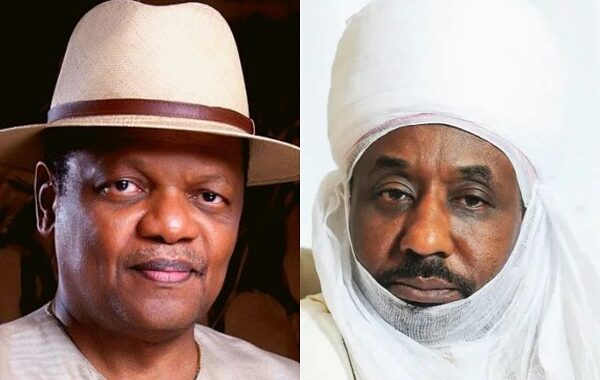
Former Central Bank of Nigeria (CBN) Governor and Emir of Kano, Muhammadu Sanusi II, on Tuesday disagreed with former Stanbic IBTC Holdings Chairman, Atedo Peterside, over the performance of President Bola Ahmed Tinubu’s administration.
Sanusi said the government deserved credit for lifting economic growth from 0.9 per cent in 2023 to about four per cent over the last three years.
Peterside, however, said growth at that level was nothing to celebrate.
The two spoke at the Oxford Global Think Tank Leadership Conference, themed “Leadership for a Prosperous Future.” Speakers examined Nigeria’s economic challenges, the need for stronger institutions, investment mobilisation, technological innovation and human capital development.
‘Give Government Credit’
Sanusi said it was not yet uhuru, but the administration should be acknowledged for what it had achieved.
For all breaking news and latest gist:
👉 JOIN GISTSMATE WHATSAPP CHANNEL“I’m not of the view that we have reached where we should, but I also think it’s only fair that we recognise the good things we have done,” he said.
“Moving from an average growth rate of 0.9 per cent to 4.5 per cent is progress. Moving from inflation of over 30 per cent to 14.5 per cent is progress. Moving from a point where, in 1999, central bank reserves were nearly negative to where we now have reserves of $55 billion is progress. We should give the government credit for that.”
He, however, said much ned to be done. “When I talk about what we lack as a country, I think, unfortunately, we need an ideological constitution,” he said.
“Are we ready to change Nigeria from a rentier state to a capitalist state? If you look at Karl Marx, a period of primitive accumulation leads to capitalism. We don’t talk about that today; we celebrate the government.”
Speaking on the downstream sector, Sanusi said the local refinery faced one hurdle after another. According to him, some people want the market opened to cheap imported petroleum products to “topple the refinery, not out of concern for Nigerians, but because it disrupts a business model of ‘rent-seeking, exploitation and theft’ that has enriched many.
He asked whether Nigeria would support local investors and anyone ready to invest in the country, rather than those who profit from rent-seeking.
Women In Governance
The former CBN governor also called for greater inclusion of women in elective and appointive positions.
“If you don’t have women in policymaking, as ministers, senators and representatives, how do you address issues of human development?” he asked.
“These are issues of maternal health, malnutrition, child education and early childhood development. Women understand and live with these issues. We need to consciously bring women to the centre of governance and decision-making if we want to get the best out of our country.”
He urged the government to listen to diverse views, saying citizens were not enemies and had a right to point out where it was falling short. He also warned that perceived regional imbalances in appointments, particularly in sensitive national security positions, could undermine national cohesion.
Beyond GDP
Sanusi said economic performance should be measured not only by GDP growth, foreign reserves and other macroeconomic indicators, but also by improvements in education, healthcare, nutrition, employment, household incomes and poverty reduction.
He cautioned against over-reliance on portfolio inflows, which he said were volatile and driven by high interest rates and attractive short-term returns.
Sustainable progress, he said, required structural reforms beyond subsidy removal and changes in foreign exchange policy. He called for investment in infrastructure, stronger accountability and transparency, reliable economic data, and policies that expand productive opportunities across the country.
Sanusi said Nigeria could attain 10 per cent growth “if we focus on a number of narrow areas. We cannot solve 100 problems.”
“Even the president’s campaign promised this: power, technology, agricultural productivity,” he said. “If you increase agricultural productivity and invest in technology, many businesses will have something to grow on.”
He noted that resources were limited. “Every time you take $10 billion out to build a road, that’s $10 billion out of electricity and $10 billion out of agriculture. These are choices driven by priorities that have an impact. can have beautiful projects that have little impact.”
Peterside, on his pa, for said Nig, ia should not be satisfied with growth of about four per cent when it needed 10 per cent to create enough jobs, expand businesses and improve living standards.
He identified weak investment as a major constraint, arguing that the required growth was unattainable without a significant increase in investment as a share of GDP.
He blamed political patronage, corruption, regulatory harassment and the absence of a level playing field for discouraging investors and weakening the private sector. Small and medium-sized enterprises, he said, often faced demands and harassment from regulators, making it difficult to expand and create jobs.
Peterside warned that public procurement had become a major channel for diverting public resources, with inflated contract costs eroding the value of government spending. He described the abuse of procurement as a form of legalised theft, saying money meant for infrastructure and public services was being lost through inflated contracts and corrupt practices.
He said Nigeria must confront corruption and state capture to attract the scale of domestic and foreign investment needed to transform the economy.
He also called for fair implementation of reforms, warning that citizens should not bear the entire burden of adjustment while the politically connected remained insulated. He urged the government to strengthen institutions, protect businesses from arbitrary interference, and ensure that appointments and the allocation of national resources were guided by merit and the national interest.
Former President of the African Development Bank (AfDB), Dr Akinwumi Adesina, said Africa’s growing young population should be treated as an economic asset, not a burden.
He said population growth alone could not guarantee prosperity. The real advantage, he said, lay in building young people’s capabilities and connecting them to productive opportunities.
Adesina noted that Africa was projected to account for about a quarter of the world’s population by 2050, with young people making up a substantial share. The trend, he said, was an enormous opportunity but could become a source of economic and social pressure if governments failed to invest adequately in education, healthcare, nutrition, technical skills and access to finance.
He said young Africans must be equipped not only to seek jobs but also to create businesses, develop technologies and solve the continent’s challenges. He stressed the need to expand digital and artificial intelligence (AI) capabilities so Africa is not merely a consumer of technologies developed elsewhere. He called for stronger investment in human capital, affordable financing, and infrastructure. Dr Bosun Tijani said Nigeria’s ability to convert knowledge and technology into productive economic activity would determine its future prosperity.
He said natural resources alone could not guarantee national wealth. Prosperity, he explained, depended on how effectively a country applied knowledge, technology and technical expertise to the resources available to it. Using the parable of the talents, he said countries that learned to multiply the value of their resources would prosper more than those that merely possessed them.
Tijani cited the liberalisation of the telecommunications sector and the introduction of GSM services in 2001 as an example of how deliberate policy, private investment and competition could transform an industry.
He described AI as the next major productivity frontier, but said Nigeria must first build the capacity to absorb emerging technologies and apply them to its own needs. The foundations, he said, were connectivity, computing and data infrastructure, skills and research, innovation capacity, and effective policies and institutions.
The minister said the government was pursuing an approximately 90,000-kilometre open-access fibre-optic network, backed by an estimated $2 billion investment, to expand broadband connectivity nationwide.
Read Also: Ekiti traditional chiefs pledge one million votes for Tinubu
He also highlighted plans to strengthen shared computing infrastructure and develop a Nigerian large language model that would support local languages, including Yoruba, Hausa and Igbo, as well as Nigerian-accented English.
According to him, the 3 Million Technical Talent programme is designed to build a pool of skilled Nigerians able to participate in the global digital economy, while th. At the same time, the National Artificial Intelligence Strategy will provide a framework for responsible AI adoption and development. An AI community of practice has also been established with initial support of $150,000 to encourage collaboration and practical application.
To illustrate the cost of failing to adopt technology, Tijani compared agricultural productivity in Nigeria with that of Brazil and Argentina. Nigerian maize yields generally range from 1.5 to 2.5 tonnes per hectare, compared with about 10 tonnes per hectare in the two South American countries, a gap he partly attributed to precision technologies and improved farming practices.
He urged businesses to take advantage of the digital infrastructure and other foundations being built, stressing that the private sector must turn those investments into products, services, jobs and economic value.
The convener of the conference and former Director-General of the Securities and Exchange Commission (SEC), Arunma Oteh, called for an ecosystem approach to development, arguing that sustainable growth required governments, businesses, investors, financial institutions and citizens to work together.
She said domestic capital markets had an important role in mobilising development finance. Increasing retail participation, she said, would allow more Nigerians to invest in productive enterprises and share in economic growthth.
Oteh also highlighted the potential of pension funds to support long-term investment and democratise wealth creation, provided appropriate safeguards and investment frameworks were in place. She cited the reported broad international participation in the proposed Dangote Refinery public offering as evidence of capital markets’ ability to attract investors beyond Nigeria.
She said investment in education, skills and employment was particularly urgent because about 70 per cent of Africa’s population was under 30.
Oteh argued that development should not be excessively centralised, as decentralisation could improve service delivery and help communities respond to local needs. She pointed to electricity supply in Aba, Abia State, as an example of the possibilities offered by decentralised management of infrastructure.
She also stressed the importance of an enabling environment for business, including reliable infrastructure, access to finance, regulatory certainty and a skilled workforce.
The speakers converged on one message: Nigeria’s challenge is not merely to record higher growth figures, but to build an economy in which investment, technology, human capital and accountable institutions combine to create jobs, raise productivity and improve citizens’ welfare.
They said achieving this would require more than isolated policy announcements. It would depend on sustained reforms, a stronger private sector, effective public institutions and deliberate investment in the capabilities of Nigerians.
WARNING: If You Are Not 18+, Don’t Click The Link Below 👇🫣
https://nya5.com/link?z=11857196&var=
Did you want to monetize your website, join MONETAG or ADSKEEPER and start earning
Please don’t forget to “Allow the notification” so you will be the first to get our gist when we publish it.
Drop your comment in the section below, and don’t forget to share the post.
Never Miss A Single News Or Gist, Kindly Join Us On WhatsApp Channel:
https://whatsapp.com/channel/0029Vad8g81Eawdsio6INn3B
Telegram Channel:
https://t.me/gistsmateNG