
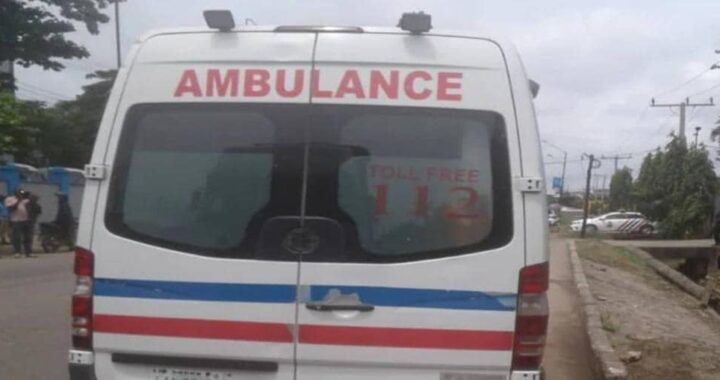
Using ambulances meant for living patients to convey corpses for burial could increase the risk of disease transmission and trigger outbreaks, particularly when the deceased died from infectious diseases, public health experts have said.
The specialists explained that the bodies of deceased persons can secrete fluids, making the handling and transportation of corpses a potential public health concern.
They noted that using the same ambulance to transport both living patients and dead bodies without appropriate disinfection and infection prevention measures could expose healthcare workers, drivers, patients and other occupants to infectious agents.
The Akwa Ibom State Government recently outlawed the use of ambulances to convey corpses for burial throughout the state.
The Akwa Ibom Commissioner for Health, Dr Ekem John, said corpses should be conveyed in hearses, warning that any ambulance, whether privately owned, state-owned or operated by a mission, caught conveying corpses for burial would be impounded.
“Corpses are carried by hearses and when you now use our ambulance to carry corpses, you are creating a public health threat to the rest of the public,” John said during a monthly media briefing.
But speaking exclusively to PUNCH Healthwise, a Professor of Public Health and Epidemiologist at the Lagos University Teaching Hospital, Idi-Araba, Adebayo Onajole, said the health implications of using ambulances for conveying corpses are multiple.
“If the ambulance is not always properly sterilised after being used for corpses, it has the opportunity to transport or transmit disease. Some of these diseases that may have resulted in the death of corpses being conveyed in ambulances may be highly infectious, and that could be a source of transmission of infection, and it could lead to an epidemic.
“Any contagious infections can be transmitted. You may not feel it much if the virulence of that infection or disease is low. But for a lot of highly virulent disease conditions, like Ebola, it will be very fatal because you will end up transmitting what we call a nosocomial infection, which is also called a hospital-acquired infection,” he said.
He urged ambulance operators to establish clear protocols for the transportation of corpses and ensure that dedicated vehicles are used where possible.
“What we advocate is that for every patient, whether living or dead, the ambulance has to be properly sterilised, cleaned out, and disinfected to reduce the possibility of transmitting any infection that may be present.
“Because sometimes, depending on how well the body has been kept, the deceased body secretes a lot of body fluids, and some of these body fluids may be highly infectious. That is why, if you have the resources available, it is always better to separate the ambulance and a hearse.
“Usually, we call the one used to carry corpses a hearse and not an ambulance, and then the one used to carry living persons an ambulance. But in Nigeria, we use the words interchangeably,” he said.
The epidemiologists stressed that proper handling of dead bodies, use of appropriate personal protective equipment and thorough decontamination of vehicles are essential to preventing avoidable infections and protecting public health.
Discover more
Nigerian economy analysis
Travel Guides & Travelogues
Nigerian news
Newspaper archives
Politics
Related News
Passengers fled buses because of my skin condition — Anambra content creator
Plateau shuts schools over diphtheria outbreak
Why traders shouldn’t use detergent to wash fruits – Nutritionists
“Basically, in all situations, it is to increase the level of hygiene, level of sterilisation and cleanliness with the hearses and with the ambulances, which also include all clothing that the dead body has come in contact with,” Onajole said.
On whether other states should outlaw the use of ambulances to convey corpses, Onajole said, “The availability of resources is critical. You are not making a policy when you cannot implement it effectively. Resources include being able to have two sets of vehicles and tag one as an ambulance and tag the other one as a hearse. But by and large, whether you are separating them or not, sterility is very important.”
Corroborating Onajole, a Public Health Physician, Dr Austine Aipoh, said the circumstances surrounding deaths of corpses being conveyed with ambulances play a major role in the risk.
He said, “It’s not all deaths that are problematic, but if the person dies of a communicable disease, especially highly communicable diseases, there is a possibility of contaminating the ambulance.
“Because a corpse leaks some fluid when they are out of the morgue, and that water can seep into the ambulance. If the person died of something like a viral or highly contagious disease like cholera or Ebola, and you use an ambulance to carry the body and leave it there for a while, you could contaminate the ambulance, and if you now use the same ambulance to carry a patient in an emergency, it could complicate the condition of that person.”
Aipoh, who is the National President, Healthcare Providers’ Association of Nigeria, stressed the need for operators to ensure proper decontamination of ambulances.
“You know the way some Nigerians are. Because decontamination takes some process, and if the ambulance is not well decontaminated, the patient being conveyed for medical care may contract another disease before getting to the healthcare facility.
“I know this is a business for some people, but my recommendation is that those in the business should differentiate the ambulance for conveying living patients and corpses. But that’s not easy, because it means the businesses will have to invest. But such investment is for the good of the public so that patients would not be at risk,” he said.
Citing examples of doctors who wash their hands before and after attending to patients, the public health physician said that decontamination should be done efficiently.
“Thorough decontamination should be part of standard operating procedures for people handling ambulance businesses, and those that are hospital-owned.
“My first recommendation is that they should separate the two. One should be for ambulances for hospital patients, and one should be a hearse used for conveying dead patients. But there are instances where they are conveying a patient and the patient dies en route.
“But the bottom line is that no matter who they carry, they should decontaminate. There should be processes of decontamination that are well spelt out in standard operating procedures. So they should make sure that they are well-decontaminated as required by law,” Aipoh said.
WARNING: If You Are Not 18+, Don’t Click The Link Below 👇🫣
Did you want to monetize your website, join MONETAG or ADSKEEPER and start earning
Please don’t forget to “Allow the notification” so you will be the first to get our gist when we publish it.
Drop your comment in the section below, and don’t forget to share the post.
Never Miss A Single News Or Gist, Kindly Join Us On WhatsApp Channel:
https://whatsapp.com/channel/0029Vad8g81Eawdsio6INn3B
Telegram Channel:
https://t.me/gistsmateNG