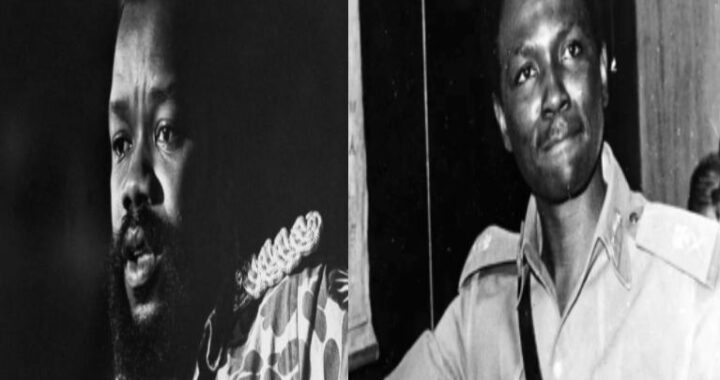
Northern military officers believed Chukwuemeka Ojukwu was complicit in the January 1966 coup d’etat and wanted to move against him, Yakubu Gowon, former military head of state, has revealed in his memoir.
Gowon, who ruled Nigeria from July 1966 to July 1975, will present his memoir, ‘My Life of Duty and Allegiance’, in Abuja today.
TheCable saw an advance copy of the book, published by the Havilah Group, Lagos.
In the January 1966 coup executed by officers mostly of Igbo origin, key northern leaders and military officers were killed.
Abubakar Tafawa Balewa, the prime minister; Ahmadu Bello, premier of the Northern region; Ladoke Akintola, premier of the Western region who was their political ally; and Festus Okotie-Eboh, minister of finance, were all killed.
Zakariya Maimalari, a brigadier and the most senior military officer from the north, was also killed alongside many other northerners in the military.
The coup failed and Johnson Aguiyi-Ironsi, a major general and the army chief, became the head of state.
‘OJUKWU REJECTED MY FRIENDSHIP’
The reverberations from the failed coup led to the counter coup of July 1966 in which Aguiyi-Ironsi was killed.
Gowon, then a lieutenant colonel and army chief, was made the head of state after the countercoup led by northern officers.
Ojukwu, a colonel who was then the governor of the now defunct Eastern region, refused to accept Gowon’s leadership, insisting that the most senior army officer, Babafemi Ogundipe, a brigadier, should have been appointed to the position.
Ojukwu declared the secession of Biafra from Nigeria in May 1967, leading to a 30-month civil war
Gowon was a lieutenant colonel — two ranks below Ogundipe — when he assumed office as head of state.
Joseph Wey, a commodore, and Adeyinka Adebayo, a colonel, were also senior to Gowon, and he was promoted to major-general and later full-star general within one year.
“The case of Brigadier Babafemi Ogundipe was, however, not as straight forward because the course of the coup had made it obvious that he could no longer function effectively in the command-and-control structure of the Nigerian Army and the Armed Forces. With the concurrence of the UK government, he was appointed Nigeria’s High Commissioner to the UK,” Gowon wrote.
“Ojukwu refused my offer of friendship. By extension, he wilfully refused to recognise my leadership. He felt that the ‘normal’ protocol of seniority in service should have been upheld in selecting General Ironsi’s successor under the new administration, regardless of the circumstances by which I assumed power. Admiral Wey effectively persuaded former Supreme Military Council members to take cognisance of the situation and support my leadership, highlighting my ability to command respect from junior officers and my willingness to lead during a difficult time.”
‘I WANTED TO WORK WITH OJUKWU’
Gowon did not believe Ojukwu was supporting Ogundipe or defending the army hierarchy for altruistic reasons.
He wrote: “Left unsaid at the time was Ojukwu’s strong view that I was junior to him in the hierarchy. He failed to appreciate that he had been under serious threat because the young Northern officers believed he was complicit in the January 15, 1966 coup.
“I pre-empted any attempt to move against him, in part, because of my respect for all the Regional Governors and, more importantly, because I saw him primarily as a colleague and officer with whom I thought I had worked to restore normalcy in those early days of uncertainty. I believed that, together, we could rebuild the army and allow the country to continue its course in history.”
Despite his reservations, he went ahead and retained Ojukwu as the governor of the East.
“My decision to retain Ojukwu in office was altogether altruistic though subsequent events made it seem a huge mistake. But with the situation at hand, it did not matter whether he agreed or not with the fact that change had occurred. Even if he did not agree with my new role, the soldier in him never said he would leave the Army. I let him be,” Gowon wrote.
Ojukwu subsequently declared the secession of Biafra in May 1967 over the reprisal killing of Igbos in the north after the January 1966 putsch.
This led to a 30-month civil war which came to an end in January 1970 with the surrender of Biafra.
WARNING: If You Are Not 18+, Don’t Click The Link Below 👇🫣
https://wrathful-piano.com/zBn8jS
Did you want to monetize your website, join MONETAG or ADSKEEPER and start earning
Please don’t forget to “Allow the notification” so you will be the first to get our gist when we publish it.
Drop your comment in the section below, and don’t forget to share the post.
Never Miss A Single News Or Gist, Kindly Join Us On WhatsApp Channel:
https://whatsapp.com/channel/0029Vad8g81Eawdsio6INn3B
Telegram Channel:
https://t.me/gistsmateNG