
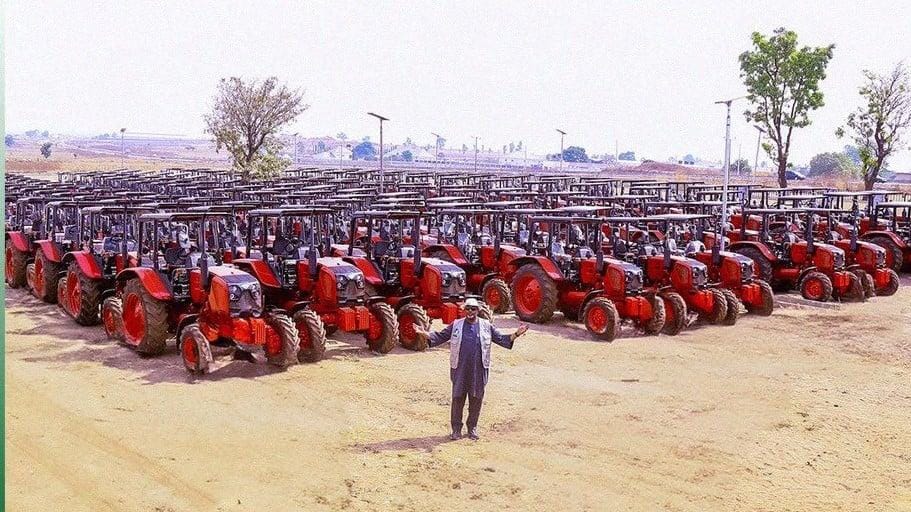
On the outskirts of Gwagwalada, Abuja, within the vicinity of the National Agricultural Seeds Council (NASC), rows of red-and-black machines sit in silence.
Tractors, bulldozers and mobile workshops—lined up neatly—are gathering dust. They are fully mechanised farm equipment shipped more than 7,800 kilometres from Belarus to Nigeria, intended to transform smallholder farming, reduce back-breaking labour and boost agricultural yields.
In June 2025, these machines were unveiled to national fanfare. President Bola Tinubu launched the Renewed Hope Agricultural Mechanisation Programme, also known as the Belarus Project, promising a turning point for Nigeria’s food system.
Implemented in collaboration with AfTrade DMCC and supported by the Republic of Belarus, the programme was framed as a bold intervention to modernise agriculture and attract young Nigerians back to cultivating the land.
Under the initiative, Nigeria took delivery of 2,000 tractors, 10 combine harvesters, 12 mobile workshops, 9,000 farming implements and 9,000 spare parts kits. The president said their deployment would empower mechanisation service providers, create jobs, ease farming operations and make agriculture “more sexy” for Nigerian youths.
Government officials repeatedly emphasised the scale and significance of the project. Abubakar Kyari, minister of agriculture and food security, described it as “the single largest mechanisation drive ever undertaken in our country”.
Follow us for breaking news:
👉 JOIN WHATSAPP CHANNEL“Never in Nigeria’s history have we witnessed an agricultural mechanisation initiative of this scale, ambition, and national focus,” Kyari said.
According to projections by the ministry, the programme was expected to cultivate more than 550,000 hectares of farmland, produce over two million metric tonnes of staple food, create more than 16,000 jobs, and directly benefit at least 550,000 farming households. It also promised mandatory operator training, GPS-enabled equipment tracking, and free allocations to research and training institutions.
But nearly seven months after the grand launch, the reality on the ground tells a different story.
Investigations by TheCable showed that a significant number of the machines remain unused and undistributed — parked in Abuja, far from the farmers they are meant to serve, and with Nigeria still waiting for the promised dividends of one of its most ambitious agricultural investments.
When contacted, Ezeaja Ikemefuna, assistant director of information at the ministry of agriculture, said the mechanisation programme includes a leasing component and that the federal government had mandated the Bank of Agriculture (BoA) to oversee the distribution of the equipment.
Further checks by TheCable showed that in November 2025, the BoA published a call for applications for the leasing and acquisition of the equipment on its website and social media platforms.
According to details in the application flyer, the tractors are to be leased for a period of three to five years at an interest rate of 15 percent, with applicants required to make a 25 percent down payment. Eligible “youth agripreneurs” must be aged between 18 and 35.
The timeline of events suggests that a clear distribution framework or strategy may not have been in place before or during the acquisition of the tractors. Although the first batch of the machines arrived months earlier, the call for applications for leasing and acquisition was only issued months later, raising questions about whether a structured plan existed at the point of delivery.
In December, Ayo Sotinrin, managing director of the BoA, said the bank had received more than 100,000 applications, which were being screened down to 4,000 and eventually to 2,000 companies.
When TheCable asked for an update on the rollout, Sotinrin said distribution had already begun. In a WhatsApp response to TheCable, he said tractors and other equipment were being deployed. He promised to share contact details of the bank’s communications team for further clarification on the process.
“Yes, it has started already. Tractors have started going out and also other equipment,” Sotinrin said, sharing videos showing a tractor tilling farmland.
However, despite follow-up enquiries, no additional information was provided on the scale of distribution or locations of deployment.
As of the time of reporting, the BoA has not publicly disclosed how many beneficiaries have been approved or how many tractors have been deployed under the scheme.
MECHANISED FARMING IN NIGERIA: THE TRACTORISATION SITUATION
In 2025, officials of the ministry of agriculture took a picture in front of the tractors from Belarus
The ministry of agriculture, in its National Agricultural Technology and Innovation Policy 2022-2027, said the agricultural mechanisation level in Nigeria is one of the lowest in the World.
According to the report, Nigeria’s mechanisation is at 0.027 hp/hectare, as against the FAO’s recommendation of 1.5 hp/hectare.
“Inadequate technological inputs, particularly in production and farm-level processingequipment such as tractors, power tillers, harvesters, threshers, crushers, choppers, hay balers and milkers have reduced the amount of land area under cultivation and contributed to low crop and livestock productivity, and high post-harvest losses in thecountry,” the report reads.
“Thus, the promotion and deployment of appropriate technologies for crops, livestock and fisheries production, processing and marketing will enhancetheproductivity and competitiveness of the sector. The envisaged increased publicandprivate sector investments, as well as development supports, are expected togenerateabout 2 million jobs.”
Also, in March 2024, Kyari, while speaking at the food security debate at the house of representatives, said Nigeria needs at least 72,000 units of tractors to successfully embark on mechanised farming.
With thousands of tractors lying idle, Nigeria remains trapped in a cycle of low productivity, despite owning the very tools meant to break it.
Rildwan Bello, co-founder and managing director of Vestance, an agribusiness consulting and research firm, said Nigeria’s mechanisation gap is stark when viewed through tractor density — the number of tractors per 1,000 hectares of farmland.
Nigeria, he said, has less than one tractor per 1,000 hectares and fewer than 5,000 functional tractors nationwide. At a minimum, he estimated that the country needs about 150,000 tractors to support agricultural production at scale. To illustrate the deficit, he likened Nigeria’s situation to having just one tractor to service the 1,032 hectares of the University of Ibadan landmass.
“That’s why you see agricultural students doing their practicals in 2026 with a hoe and a cutlass,” he said.
While tractors are only one part of mechanisation, Bello explained that their importance lies in their versatility.
He argued that the persistent shortage points to long-standing implementation failures rather than a lack of policy intent. He questioned what had become of tractors procured by successive governments, noting that weaknesses in deployment, maintenance, and technical capacity often led to equipment breaking down and disappearing from use.
According to him, this has left the country repeatedly restarting mechanisation efforts without addressing underlying structural problems. He said the federal government’s role should focus on enabling private-sector-led mechanisation rather than directly managing tractor procurement or leasing.
Bello explained that this would involve supporting businesses to operate and maintain equipment at scale, subsidising leasing costs for farmers, and building a skilled workforce to service machines when they break down.
Progress, he said, is likely to be incremental; but even modest gains, if well tracked and sustainably managed, could begin to close Nigeria’s mechanisation gap.
FOOD SECURITY IN NIGERIA
Food items displayed in a market
Food items displayed in a market
In July 2023, shortly after assuming office, Tinubu declared a state of emergency on food security, acknowledging the growing difficulty many Nigerians faced in accessing affordable food. At the time, rising inflation, insecurity in major food-producing regions and declining agricultural productivity had combined to push millions of households into vulnerability.
It was against this backdrop that the federal government announced large-scale mechanisation as a central pillar of its food security strategy. The Renewed Hope Agricultural Mechanisation Programme was presented as a practical response to low productivity, promising to accelerate land preparation, expand cultivated areas and stabilise food supply.
However, the timing of implementation has raised serious questions. The first tranche of tractors arrived in March 2025, just weeks before the onset of the wet farming season, which typically runs from April to October and is critical for planting most staple crops. Yet, as the planting season began, much of the equipment remained undistributed.
Instead of rapid deployment to farming communities, the ministry of Agriculture in June 2025 declared a three-day fasting and prayer programme, calling for divine intervention in the agricultural sector. For many farmers, this coincided with another season of delayed land preparation and reduced output.
For a country grappling with widespread hunger, the implications are profound. Each missed farming season translates into lost production, tighter food supply and higher prices for consumers. It also undermines confidence in the government’s food security strategy, raising questions about how an idle mechanisation programme aligns with repeated promises to curb hunger, stabilise prices and build a more resilient agricultural system.
NIGERIAN YOUTHS IN AGRICULTURE
As of Sunday, February 1, hundreds of tractors and other equipment imported from Belarus were stored in a compound in Abuja
Nigeria has one of the youngest populations in the world, yet agriculture, despite being a major employer, struggles to attract and retain young people.
For many youths, farming is still associated with drudgery, low returns, and physical exhaustion rather than innovation, income, or opportunity. This perception is closely linked to the sector’s limited use of mechanised tools and modern technology.
According to ActionAid, a non-governmental organisation, engaging 40 million youths in agriculture could add ₦60 trillion annually to Nigeria’s GDP.
It added that a one percent increase in agricultural employment and youth participation in agriculture can cut poverty by up to 59 percent in Nigeria.
In August, the federal government unveiled the 2025–2030 revised National Youth Manifesto in Agriculture for Nigeria intended as a youth-owned roadmap for the future of agriculture in Nigeria.
“This manifesto is proof that the young populace is not just beneficiaries of policy but architects and drivers of the nation’s agricultural future,” Kyari said at the launch.
Also launched at the event in Abuja was the 2025 Nigerian Youth in Agribusiness Call to Action, a framework designed to reposition young people at the heart of agricultural transformation.
Umar Farouq, a young farmer, said agriculture has become more appealing to Nigerian youths in recent years, but government policies have failed to keep pace with this growing interest. He noted that policy gaps continue to pose major challenges for young people trying to enter or scale within the sector.
He explained that agriculture is now more technologically driven than in the past, and the need for tractors depends on the type of farming involved. According to him, many young farmers are already doing well without owning tractors, though they still rely on some technology.
He noted that increased food production requires more than just distributing tractors. Access to inputs, finance, land, and markets, he said, matters just as much, questioning whether past tractor-sharing schemes have delivered any real change.
But with continued delay in deploying the equipment, the government risks turning a youth-focused agricultural promise into another missed opportunity.
Credit: TheCable
WARNING: If You Are Not 18+, Don’t Click The Link Below 👇🫣
https://troubleduseful.com/u36k6hvh?key=9d5a995551042f49ca200d04746b52ad
Please don’t forget to “Allow the notification” so you will be the first to get our gist when we publish it.
Drop your comment in the section below, and don’t forget to share the post.
Never Miss A Single News Or Gist, Kindly Join Us On WhatsApp Channel:
https://whatsapp.com/channel/0029Vad8g81Eawdsio6INn3B
Telegram Channel:
https://t.me/gistsmateNG