
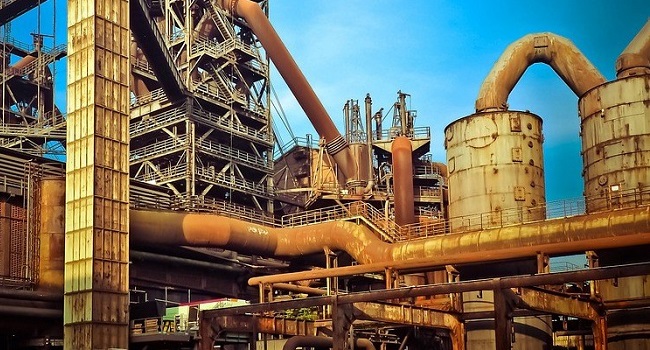
The Federal Government has proposed to spend N6.04 billion on personnel costs for Ajaokuta Steel Company Limited in the 2026 fiscal year, even though the steel complex has remained non-operational more than four decades after it was conceived.
Data from the 2026 Appropriation Bill shows that the company was allocated a total of N6.69 billion for the year, with personnel expenses alone accounting for about 90.4% of the entire provision.
The structure of the allocation reinforces Ajaokuta’s long-standing role as a non-producing public enterprise sustained largely by salary payments rather than industrial activity.
What Does The 2026 Proposed Budget Show
Nairametrics observed that of the N6.04 Billion earmarked for personnel, N4.79 billion is for salaries and wages, while N1.25 billion is set aside for allowances and statutory social contributions.
These include N479.42 million for employer pension contributions, N239.71 million for NHIS payments and N59.82 million for employees’ compensation insurance. Regular allowances alone amount to N468.9 million.
A closer look at the proposed 2026 budget shows a sharp imbalance between recurrent and capital expenditure. Total recurrent spending for Ajaokuta stands at N6.28 billion, while capital expenditure is limited to N410.8 million.
This means that less than 7% of the company’s total allocation is directed towards assets, rehabilitation or infrastructure.
The capital budget itself is thinly spread across minor items. Fixed asset purchases such as computers, printers and security equipment account for N56.4 million.
Construction and provision of facilities take N129.2 million, while rehabilitation and repairs are allocated N225.2 million, largely for electricity-related works and office buildings.
These figures highlight how little funding is being channelled toward reviving a heavy industrial complex originally designed to anchor Nigeria’s steel and manufacturing value chain.
Year-on-year Trends Show Persistence, Not Reform
An examination of recent budget trends shows that the 2026 figures represent continuity rather than reform. In 2024, personnel costs at Ajaokuta stood at N4.29 billion.
This jumped to N6.21 billion in 2025, representing a 44.8% increase despite the absence of production. The proposed N6.04 billion for 2026 reflects only a marginal 2.7% reduction from the previous year.
While the slight decline may appear like restraint on paper, it does not alter the underlying structure of spending.
Salaries continue to dominate the budget, while capital investment remains compressed, confirming that staff remuneration remains the core priority rather than steel output.
Zero Revenue And Dependence On Federal Payments
The budget document indicates that Ajaokuta is projected to generate zero independent revenue in 2026 and will receive no grants. This leaves the company fully dependent on federal subventions for survival.
Despite this, it continues to feature in constituency-style capital projects such as solar street lighting in parts of Niger East and Kwara North, water facilities, road repairs, security lighting and grants to market women and youths.
These projects, although ongoing, are not linked to steel production or industrial capacity and do little to change the company’s non-operational status.
However, separate from Ajaokuta’s own allocation, the proposed 2026 budget includes provisions for revival-related activities under the Federal Ministry of Steel Development.
The ministry allocated N150.99 million for the revitalisation of Ajaokuta Steel Company Limited and the National Iron Ore Mining Company, classified as an ongoing capital project.
Also, N1.06 billion was set aside for project preparation aimed at investment mobilisation for Ajaokuta.
This covers feasibility studies, Environmental and Social Impact Assessments and financial modelling.
While these signals continued planning activity, it also shows that spending remains concentrated on preparatory work rather than physical recommissioning.
The 2026 provisions are notably lower than in 2025, when the ministry budgeted N2.41 billion for project preparation and N250.98 million for revitalisation of Ajaokuta and NIOMCO.
The decline points to a 56% drop in project preparation spending year on year, even as the steel complex remains idle.
What You Should Know
Conceived in 1979 as Nigeria’s flagship industrial project, the Ajaokuta Integrated Steel Complex was expected to reduce steel imports, drive industrialisation and support economic diversification.
More than 40 years later, budget allocations suggest it functions largely as a payroll institution, with successive governments funding salaries while production remains at zero.
On its website, the company says it employs about 3,000 workers and claims that full commissioning could directly engage about 10,000 staff, with upstream and downstream industries potentially supporting up to 500,000 jobs nationwide.
For now, the proposed 2026 budget figures show a steel plant sustained by recurrent spending, with revival still confined to studies and plans rather than output.
WARNING: If You Are Not 18+, Don’t Click The Link Below 👇🫣
https://troubleduseful.com/kx6iepv2qm?key=6c14bd1d68e1eba721851f19778f5efe
Please don’t forget to “Allow the notification” so you will be the first to get our gist when we publish it.
Drop your comment in the section below, and don’t forget to share the post.
Never Miss A Single News Or Gist, Kindly Join Us On WhatsApp Channel:
https://whatsapp.com/channel/0029Vad8g81Eawdsio6INn3B
Telegram Channel:
https://t.me/gistsmateNG
6.4Billiion at what profit?Naija my Country.Make them kukuma use d money import steel from China.