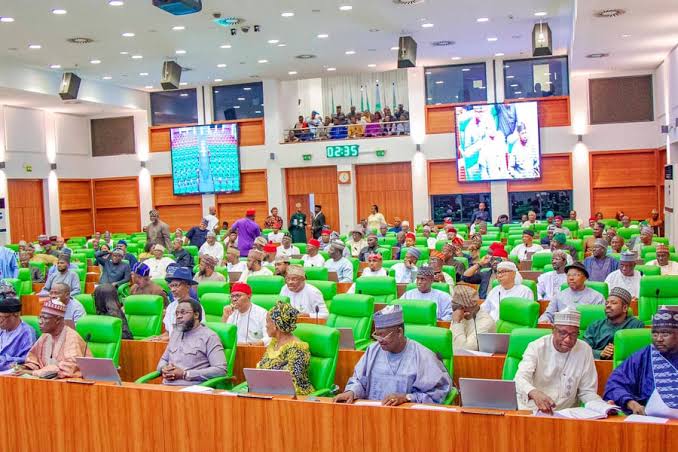
The House of Representatives has stepped down consideration of the reports on the 2026–2028 Medium-Term Expenditure Framework (MTEF) and the Fiscal Strategy Paper (FSP) following an extensive debate that exposed disagreements over key macroeconomic assumptions, particularly crude oil benchmark prices and their implications for government revenue.
The reports were presented by the chairperson of the Joint Committees on Finance and National Planning and Economic Development, James Faleke, during Wednesday’s plenary.
Shortly after he laid the documents, the House dissolved into the Committee of Supply to consider the findings and recommendations of the joint committees.
However, confusion over the figures proposed in the framework stalled deliberations.
The joint committee had recommended that the projected crude oil benchmark prices of US$64.85, US$64.30 and US$65.50 per barrel for 2026, 2027 and 2028. respectively, be reviewed downwards to US$60 for 2026, US$65 for 2027 and US$70 for 2028.
The recommendation, according to the committee, was informed by global geopolitical tensions in Europe and the Middle East and the volatility of international oil prices.
This recommendation immediately drew concern from the Speaker of the House, Tajudeen Abbas, who warned that altering the crude oil benchmark would have far-reaching consequences for every other figure contained in the framework.
He questioned whether the committee had sufficiently accounted for how reduced oil prices and possible production adjustments would affect total projected revenue and the overall size of the proposed 2026 budget.
Background and Committee Work
President Bola Tinubu transmitted the 2026–2028 MTEF/FSP to the House last Wednesday for legislative consideration.
The document was subsequently referred to the joint committees, which held a public hearing on Tuesday with key officials of the economic management team, including the Minister of Finance and Coordinating Minister of the Economy, Wale Edun, and the Minister of Budget and National Planning, Atiku Bagudu.
Presenting the committees’ findings, Mr Faleke said the review of submissions from ministries, departments and agencies (MDAs) and government-owned enterprises (GOEs) showed that the projected crude oil benchmark prices stood at US$64.85, US$64.30 and US$65.50 per barrel for 2026, 2027 and 2028, respectively.
He noted that Nigeria’s crude oil output performance, based on the Organisation of the Petroleum Exporting Countries’ (OPEC) output targets, had been impressive within the period under review.
According to him, Nigeria recorded one of the strongest month-on-month production gains among OPEC members in November 2025, as reflected in the December 2025 OPEC Monthly Oil Market Report.
The committee also observed that the projected exchange rates were N1,512 for 2026, N1,432.15 for 2027 and N1,383.18 for 2028, while inflation was projected at 16.5 per cent, 13 per cent and nine per cent over the same period.
Real Gross Domestic Product (GDP) growth was projected at 4.68 per cent for 2026, 5.96 per cent for 2027 and 7.9 per cent for 2028. Mr Faleke said the outlook for growth in 2026 was assessed to be high, given expectations that ongoing economic reforms would begin to yield tangible gains.
He added that the new tax regime was expected to activate broad-based economic reform and development.
In line with this, the committee observed that the federal government planned to implement a National Scanning Policy within the National Single Window of the Nigeria Revenue Services (NRS), in collaboration with relevant agencies, to enhance revenue assurance, improve trade facilitation, reduce leakages, and strengthen transparency and national security.
On expenditure, Mr Faleke said the overview of the framework for revenues and expenses showed that the proposed 2026 federal government budget stood at N54.46 trillion. Of this, N34.33 trillion was projected as retained revenue, while new borrowings of N17.88 trillion, covering both domestic and foreign loans were proposed. Debt servicing was estimated at N15.52 trillion, pensions, gratuities and retirees’ benefits at N1.376 trillion, and the fiscal deficit at N20.13 trillion.
Capital expenditure, exclusive of transfers, was projected at N20.131 trillion, statutory transfers at N3.152 trillion, and the sinking fund at N388.54 billion. Total recurrent (non-debt) expenditure was estimated at ₦15.265 trillion, with special interventions for recurrent and capital expenditure pegged at N200 billion and N14 billion respectively.
Recommendations and fault lines
In its recommendations, the committee called for the adoption of the revised crude oil benchmark prices, while sustaining domestic crude oil production projections of 1.84 million barrels per day for 2026, 1.88 million barrels per day for 2027 and 1.92 million barrels per day for 2028.
It further recommended sustaining the projected exchange rates in line with the Central Bank of Nigeria’s stabilisation policy, maintaining inflation and GDP growth projections, and ensuring the effective implementation of the new tax laws and the proposed National Scanning Policy.
The committee also advised that the proposed expenditure framework including total spending of ₦54.46 trillion, new borrowings of N17.88 trillion, debt service of N15.52 trillion, and capital and recurrent expenditure projections be sustained.
However, these recommendations triggered intense debate on the floor.
Debate
Raising concerns, Speaker Tajudeen questioned how the committee intended to accommodate the revenue shock that would arise from lowering crude oil benchmark prices and possibly adjusting production volumes.
He said reducing both the benchmark price and output would inevitably translate into lower oil revenue and asked whether the committee had clearly identified where the resulting deficit would fall.
Responding, Mr Faleke said the MTEF/FSP was still based on assumptions and that the House was expected to pass them before the budget was prepared. He argued that while the executive submitted estimates, the actual rates used in the final budget could differ, adding that the House needed to act to allow the process to move forward.
Deputy Speaker Benjamin Kalu intervened, noting that while adopting a conservative benchmark was prudent, it would still create a revenue gap. He asked whether the committee had computed non-oil revenues to determine how such a gap could be bridged.
“Granted that we reduce the production level. We are saying this is what they have projected but we are giving them a conservative approach to it. A gap is going to be created,” he said.
Mr Faleke replied that revenues outside oil and gas were not reduced under the framework and that the committee’s focus was on oil-related assumptions, including company income tax and other levies from oil firms.
Speaker Tajudeen pressed further, noting that the proposed N54.46 trillion budget was predicated on specific oil price assumptions. He argued that reducing the benchmark price to US$60 per barrel would imply a shortfall of about US$5 per barrel, which would affect expected oil and gas revenue and, by extension, the total budget size.
“If you reduce the benchmark price, as well as the production, the volume, it will translate into a reduced revenue from the crude oil part. Have you actually identified where that deficit or shortfalls will be accommodated,” he questioned.
He said the committee ought to have indicated whether the shortfall would be covered through increased domestic revenue or additional domestic and foreign borrowing. Leaving the figures unchanged, he warned, rendered the report incomplete.
Adding to the criticism, the Deputy Chairman of the Finance Committee, Saidu Abdullahi, lamented the late submission of the MTEF/FSP, saying it contravened the Fiscal Responsibility Act, which requires the documents to be submitted by September. He said the delay deprived the committee of adequate time for a detailed and rigorous analysis.
Report stepped down
Following the prolonged and inconclusive debate, Mr Faleke moved a motion for the reports to be stepped down for further consideration.
The motion was adopted by the House.
Speaker Tajudeen subsequently noted that the joint committees would carry out further work on the document and return to present a revised report to the House the following day.
The Senate approved the document on Tuesday.
WARNING: If You Are Not 18+, Don’t Click The Link Below 👇🫣
https://massivemanuscriptestimated.com/kx6iepv2qm?key=6c14bd1d68e1eba721851f19778f5efe
Please don’t forget to “Allow the notification” so you will be the first to get our gist when we publish it.
Drop your comment in the section below, and don’t forget to share the post.
Never Miss A Single News Or Gist, Kindly Join Us On WhatsApp Channel:
https://whatsapp.com/channel/0029Vad8g81Eawdsio6INn3B
Telegram Channel:
https://t.me/gistsmateNG