
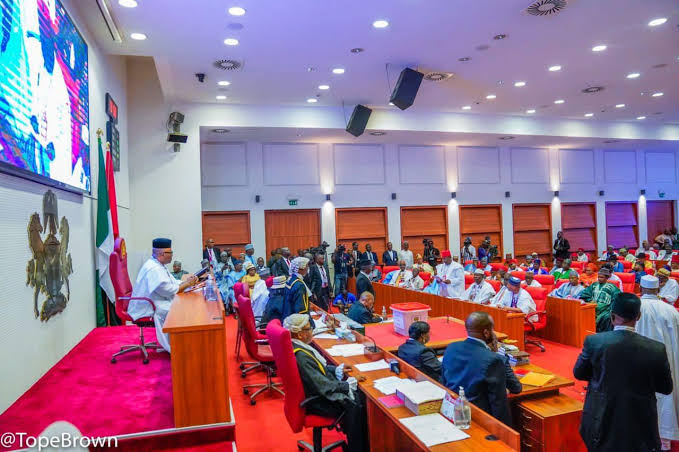
The Senate on Tuesday passed for second reading a landmark bill seeking to designate kidnapping and hostage-taking as acts of terrorism, impose the death penalty on offenders, and empower security agencies to trace and forfeit assets linked to the crime.
The bill, titled Terrorism (Prevention and Prohibition) (Amendment) Bill, 2025 (SB.969), was sponsored by Senate Leader, Senator Opeyemi Bamidele (Ekiti Central), and co-sponsored by 108 senators.
Leading the debate, Bamidele said the amendment was a direct legislative response to one of Nigeria’s most devastating security threats.
He noted that kidnapping has transformed from isolated acts into a “commercialised, militarised, and well-coordinated national menace” that has claimed thousands of lives, crippled businesses, bankrupted families, and stretched security agencies beyond capacity.
“The bill seeks to designate kidnapping and hostage-taking as acts of terrorism, prescribe the death penalty without option of fine, and empower security agencies to dismantle kidnapping networks through asset tracing, forfeiture, intelligence-led operations, and stronger inter-agency coordination,” he explained.
He added that the terror designation would give law enforcement broader prosecutorial powers under counter-terrorism frameworks, enabling faster pre-trial procedures and the disruption of funding chains that feed the criminal enterprise.
Senators across party lines endorsed the bill, describing it as urgent, overdue, and necessary to save lives.
Senate Chief Whip Tahir Monguno commended the reform-oriented elements of the bill, noting that it emphasises the training and retraining of lawyers through continuing legal education to ensure they remain aligned with modern technological realities.
He further highlighted the expanded powers granted to the Legal Practitioners Disciplinary Committee, which will now be able to more effectively investigate professional misconduct and exercise broader regulatory authority.
These powers, he said, will strengthen professional standards and bring Nigeria’s legal practice closer to global best practices.
Mungono added that the bill retains the requirement for two years of continuing legal education for newly called lawyers.
Leading the debate, Senator Bamidele outlined several far-reaching reforms contained in the bill. They include provisions for suspension, striking off, restitution, compensation, cost orders, and formal apology in disciplinary cases.
The bill also mandates the publication of disciplinary outcomes to enhance transparency and grants practitioners the right of appeal to the Supreme Court.
He announced the creation of a new Ethics, Adherence and Enforcement Committee, which will serve as a professional investigative body with authority to inspect law offices, demand documents, investigate public complaints, enforce compliance, and prosecute cases before the new Practitioners Disciplinary Committee.
Bamidele added that the bill introduces two years of mandatory pupillage for newly admitted lawyers, except in approved special cases and mandatory continuing professional development as a requirement for renewing a practising licence.
He also noted that the bill criminalises unauthorised legal practice amid rising concerns about impostors posing as lawyers.
It clearly defines what constitutes legal practice, sets rules for regulating foreign lawyers, and introduces financial safeguards to protect citizens from fraud.
According to him, these reforms represent the most sweeping transformation of Nigeria’s legal profession in decades, aimed at strengthening discipline, competence, client protection, and public trust.
Senator Adams Oshiomhole expressed full support for the bill but drew attention to a critical loophole it seeks to close, one that previously allowed serious offenders, including terrorists, to evade full punishment through de-radicalisation programmes.
He criticised past instances where individuals arrested for terrorism, murder and other heinous crimes were reintegrated into society with state support, only to return to terrorism.
Such developments, he said, have demoralised security agencies and eroded public confidence.
Oshiomhole stressed that with kidnapping now fully incorporated into the terrorism framework, the strengthened Terrorism Act eliminates unnecessary discretion and mandates strict prosecution.
Those who kill, maim, burn or massacre innocent citizens, he argued, should no longer be treated as victims needing rehabilitation but should face the full weight of the law, including the death penalty where applicable.
He insisted that there must be no more de-radicalisation for persons arrested for terrorism or kidnapping. Once apprehended, they must face trial and, if convicted, face the consequences. This, he said, honours victims, protects security forces, and restores integrity to the justice system.
Senator Orji Kalu declared that there was no dissent among senators regarding the bill. He recalled that during the closed session, members unanimously agreed that the bill should be passed and transmitted to the President for assent.
Kalu described kidnapping as one of the most devastating crimes affecting Nigeria, insisting that the nation must no longer tolerate those who perpetrate it. He emphasised that the bill is timely, necessary and long overdue.
The senator called for stringent action not only against the kidnappers but also against all who aid or abet the crime, whether by providing houses, logistics or other forms of support. He stressed that no one, including security personnel, should escape accountability.
He lamented the growing attacks on innocent citizens and the collapse of businesses due to the kidnapping menace, adding that women continue to suffer random assaults from criminals.
Supporting the bill, Senator Abba Moro said the legislation clearly defines kidnapping as a serious criminal offence and outlines appropriate punishments.
Advancing the bill to the second reading, he argued, is necessary to serve as a strong deterrent to the rising incidence of kidnapping.
Moro noted that kidnapping has tragically evolved into a commercial enterprise, driven by ransom negotiations and massive financial gains. The bill, he said, seeks to disrupt this cycle.
He also urged a deeper investigation into the root causes of the crime. While some justify drug use and criminality with socioeconomic hardship, he said millions of law-abiding Nigerians equally face these conditions without resorting to crime.
Senator Victor Umeh described the brutal murders of kidnapped victims nationwide as evidence of the horror and heartlessness behind the crime. He noted that even after families pay enormous ransoms sometimes exceeding ₦100 million, victims are still killed.
According to Umeh, individuals who engage in such evil acts do not deserve mercy, and the law must deal decisively with them. Since the consequences of kidnapping mirror those of terrorism, he said, capital punishment is justified.
Umeh also drew attention to financial institutions, arguing that ransom payments involving huge sums cannot pass through banking systems without detection.
Banks that process such transactions but fail to offer useful leads, he said, contribute indirectly to the crime and must be held accountable.
He insisted that both kidnappers and sponsors must be treated equally under the law, as sponsors benefit from the proceeds of kidnapping and should face identical punishments.
Stricter monitoring of financial transactions, he said, must be a core element of the legislative process.
Presiding over the session, Senate President Godswill Akpabio emphasised that any Act of the National Assembly supersedes conflicting state laws and applies across the federation.
“Too many people, professionals and ordinary citizens alike, are drifting into kidnapping as if it were a legitimate trade. We cannot allow this to continue,” he said.
Akpabio directed the concerned committees to immediately commence work, conduct public hearings, and incorporate all relevant recommendations.
Following an overwhelming voice vote, the Senate passed the bill for second reading. It was referred to the Senate Committees on Judiciary, National Security and Intelligence, and Interior for further legislative work and public hearing.
If enacted, the bill will fundamentally reshape Nigeria’s counter-kidnapping framework by classifying the crime as terrorism, enabling asset forfeiture, eliminating de-radicalisation loopholes, and imposing the death penalty as the ultimate deterrent.
WARNING: If You Are Not 18+, Don’t Click The Link Below 👇🫣
https://massivemanuscriptestimated.com/kx6iepv2qm?key=6c14bd1d68e1eba721851f19778f5efe
Please don’t forget to “Allow the notification” so you will be the first to get our gist when we publish it.
Drop your comment in the section below, and don’t forget to share the post.
Never Miss A Single News Or Gist, Kindly Join Us On WhatsApp Channel:
https://whatsapp.com/channel/0029Vad8g81Eawdsio6INn3B
Telegram Channel:
https://t.me/gistsmateNG